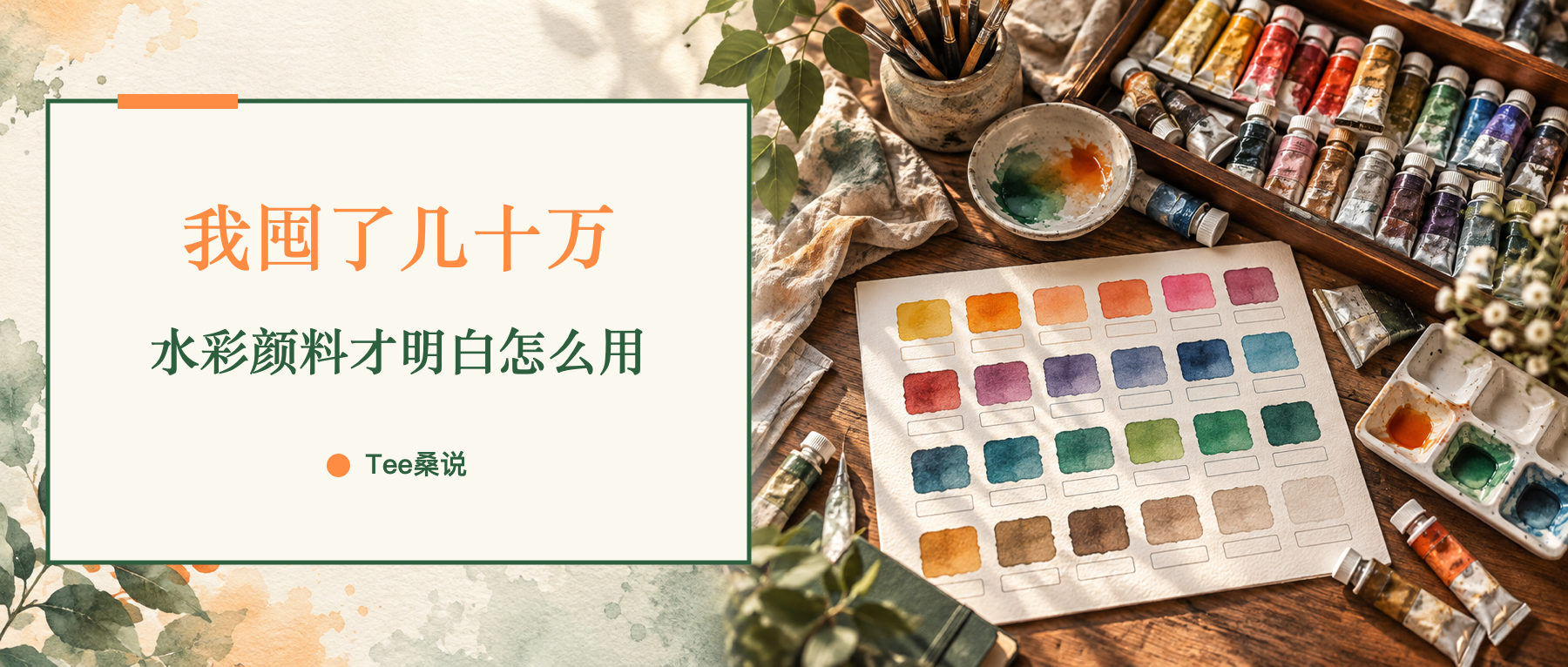
During the years I taught watercolor, one of the questions students asked most often wasn't how to paint. It was which colors to buy.
It sounds like a simple question, but it's actually hard to answer. Open almost any brand's color chart and you'll find over a hundred colors, sometimes more than two hundred. Putting a beginner in front of that row of colors is like putting them in front of a buffet. Their eyes can't take it all in, and their hands have no idea where to start.
My solution at the time was rather blunt: stop agonizing and buy them all.
That was what I did, anyway. I brought home one complete set after another, brand by brand, until I had more than a thousand tubes of paint. If a student asked whether a particular color looked good or was worth buying, I didn't need to consult a digital chart. I could squeeze it out and test it for them on the spot. Digital charts online can misrepresent colors. Mine were real, alive on the paper.
I thought this was an especially thoughtful service. As it turned out, very few people actually came to look at my charts.
Over the past few years, something has gradually dawned on me. When a brand develops more than two hundred colors, not every one of them is waiting to be used by every painter. Look at painters who have been at it for years. They keep coming back to the same dozen or twenty staple colors, starting with the basics in a set and adding two or three favorites to suit their habits. With just those paints, a little mixing and a little dilution can produce a complete painting.
So what are all the other colors for?
Some are there to make the brand look impressive. Some help fill out its color range. And of course, there's also the hope that you'll buy a little more. But for an individual painter, most of those colors may never be squeezed out of a tube even once in a lifetime.
My own paints are the most direct evidence of this paradox. More than a thousand tubes, enough to cover an entire table when spread out, yet the ones I actually use regularly are always the same small handful.
Meanwhile, the less-used ones are quietly drying out in their boxes.
Watercolor paint dries out. I honestly never considered that when I was buying it. I assumed that such prestigious brands and such expensive paints ought to keep well. I even specifically asked brands how long a tube of watercolor would last. They said twenty or thirty years would be no problem. But even if it's still usable after twenty or thirty years, paint that has dried inside a tube won't squeeze out. You have to cut the whole tube open with scissors and dig it out, like scraping the last bit from a tube of toothpaste. If cheap paint dries up, I can live with it. But when something this expensive dries up, it feels a bit much. I cut open one tube after another until I didn't even want to count them. Back then, I spent hundreds of thousands of yuan on art supplies alone. Looking back over these years, honestly, I do regret it a little.
A friend suggested selling them on Xianyu. Recover whatever money I could. I couldn't bring myself to do it. I'd chosen and paid dearly for each of these things. Why should I sell them at a discount? They hadn't gone bad. They were still usable. They just needed a chance to be used.
As it happened, AI gave them that chance.
Seven or eight years ago, I'd already thought about organizing the color charts I had so that people looking to buy paint would have somewhere to look things up. How did I do it back then? Entering each color code by hand, adding Chinese and English names, copying and pasting. By the end of the day, my eyes would be glazed over and the progress bar would barely have moved. It felt like the kind of job a person could never finish. I gave up halfway through.
Now it's different. I gave AI my hand-painted charts along with the digital material from the brands and had it help organize everything. I entered six or seven brands in one go, with both Chinese and English notes. The same idea that had sat stuck for seven or eight years was online in a few days once I changed tools. Looking at those rows of color codes on the screen, a thought came to me: Something I'd been stuck on for seven or eight years was finished in a few days. So what exactly had I been stuck on back then?
Go to teesoho.com and click “Watercolor Charts” to see it.
I've also been away from posting online for about seven or eight years. Lots of new Chinese brands have appeared in that time, and I haven't used any of them. I plan to catch up gradually, contacting brands for information or buying paints to try myself. The unused paints I already have shouldn't just sit there either. I'm planning to make small single-color studies with each one.
With watercolor, a chart alone can't show you everything. The same color can look completely different depending on how much water you add. Some colors separate when diluted, or produce settling pigment granules. You have to try them with your own hands to find out. That's also one of the most interesting things about watercolor as a medium.
I have more than a thousand tubes from different brands, so I can try them one by one, make little studies, and link them to their entries in the color charts. For me, it's more like a regular practice, something with a sense of ritual.
At this point, I should mention Xiaohongshu.
I started posting on Xiaohongshu in January 2021, focusing on watercolor mixing. In six months, I gained five or six thousand followers, and every post had people interacting in the comments. But in June, I stopped. The numbers hadn't dropped. I just felt I was doing it for the sake of doing it, with no larger purpose in mind. After a while, I lost the motivation.
I see it differently now. Back then, it felt pointless because I was only looking at the numbers. But those posts really did help people. Things sitting in someone's saved collection may be opened and used one day. AI also makes pulling everything together much faster and less laborious. I don't need to shoulder all that work alone anymore. So I'm planning to start updating my idle Xiaohongshu account again.
This, then, is the lesson I paid to learn: don't stockpile paint. It dries out. Buy only as much as you'll use. I mean that. But if you already have paints, or you're considering a color and aren't sure about it, these organized charts can be useful. If you want to know what a color looks like or how to mix one, you can leave a message, send me a private message, or ask me directly if we're already connected on WeChat. I'll do my best to give you a little practical reference grounded in actual painting.
Making something isn't the end of it. It counts when someone puts it to use.
What did this bring to mind?
Share a memory, a different view, or a thought you would like to continue. No account is needed. Comments appear after review; readers’ words remain in their original language.
Conversation
Loading comments…