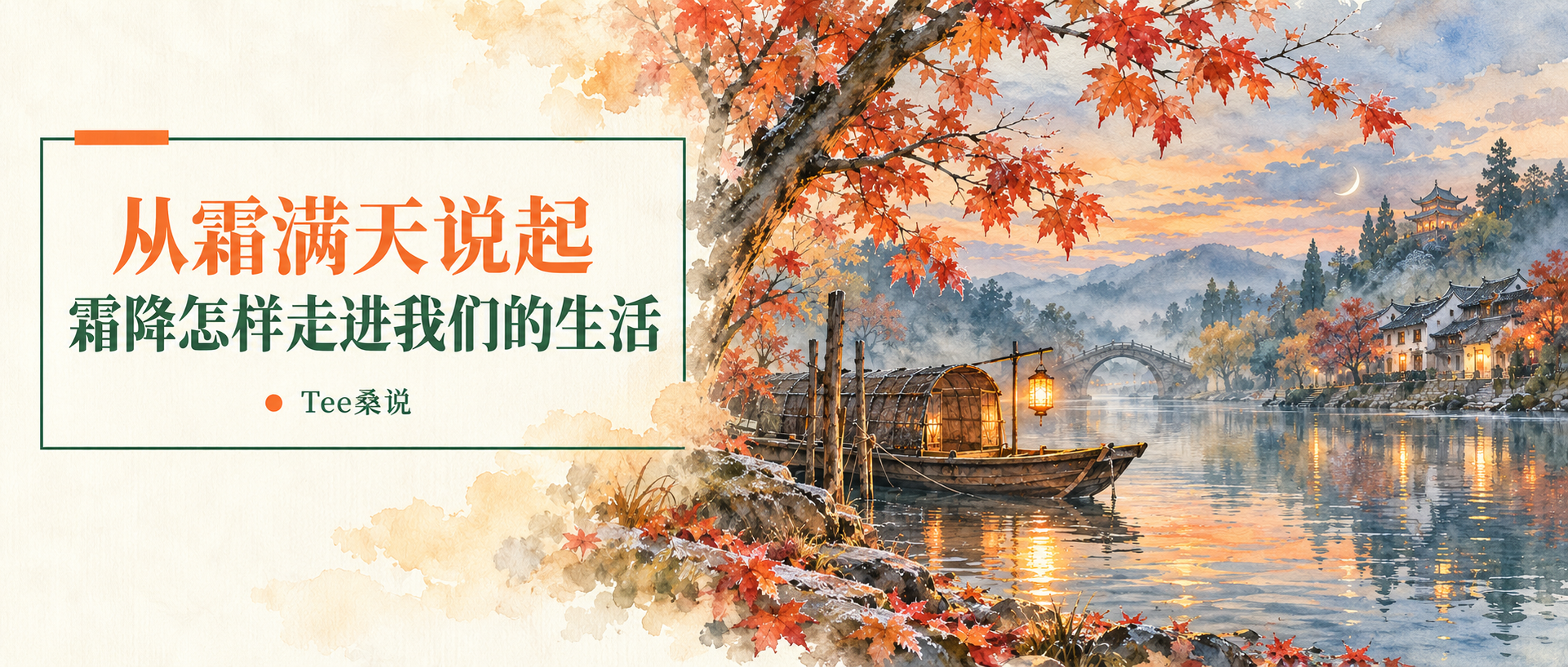
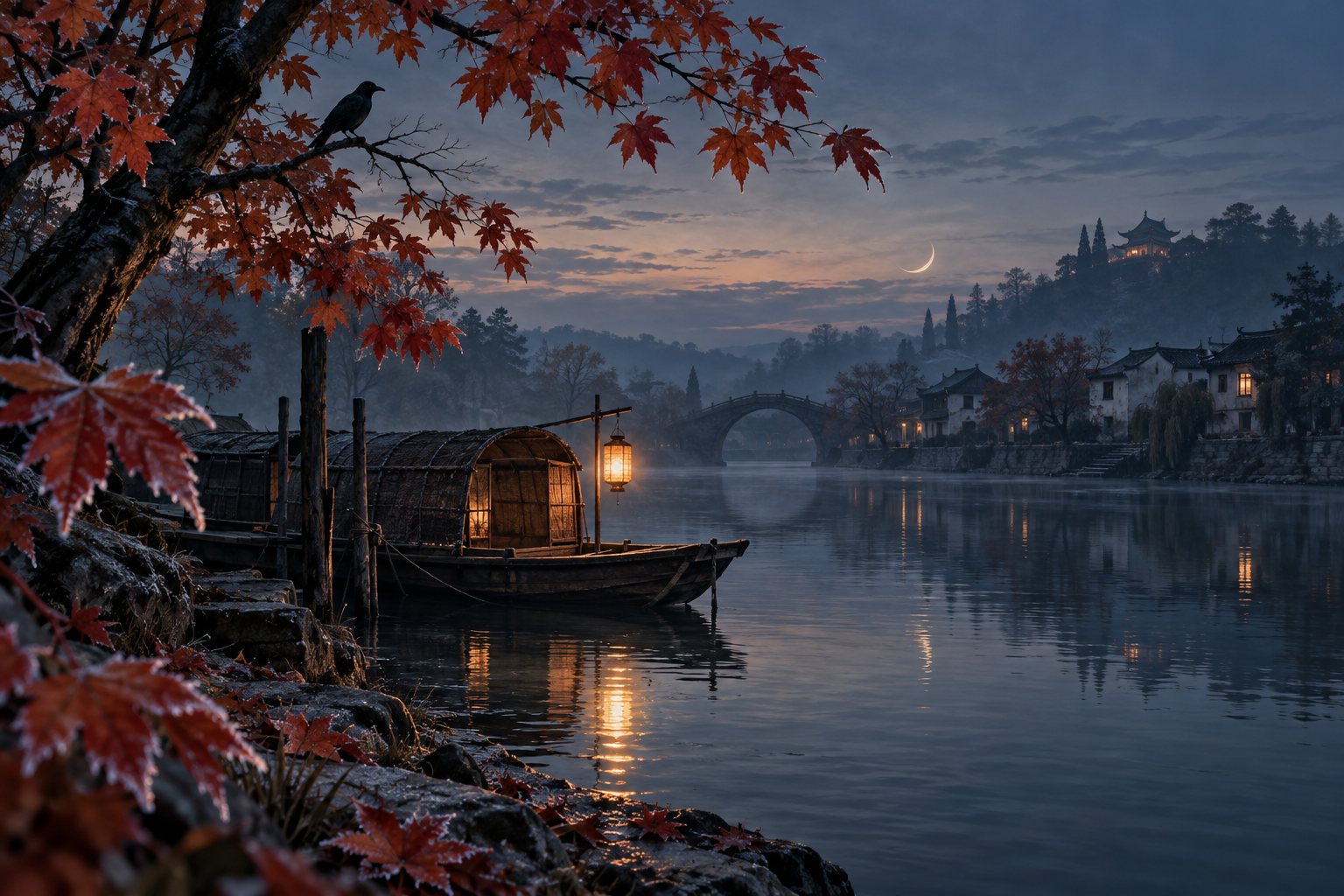
When frost comes up, many people first think of a line of poetry they learned as children.
“The moon sets, crows cry, and frost fills the sky; riverbank maples and fishing lights face my troubled sleep.”
The moon, the crows, the fishing lights, and someone who cannot get to sleep. Even if we have never moored a boat in Suzhou in late autumn, those two lines let us feel the cold of that night.
Song Yingjie also mentioned this poem, “Night Mooring at Maple Bridge,” in his discussion of Frost Descent on Sanlian Zhongdu. The chill of a night in a poem, a vegetable seller's mention of “frost-touched greens,” or white ice crystals on an outdoor car window at dawn can all make Frost Descent feel more tangible.
Following these experiences a little further, we begin to see how weather, farming and people's lives connect through the solar terms.
Frost forms on the ground, but the chill can “fill the sky”
“Frost fills the sky” can easily bring to mind white frost falling through the air like a light snowfall.
To understand how frost forms, we need to look close to the ground.
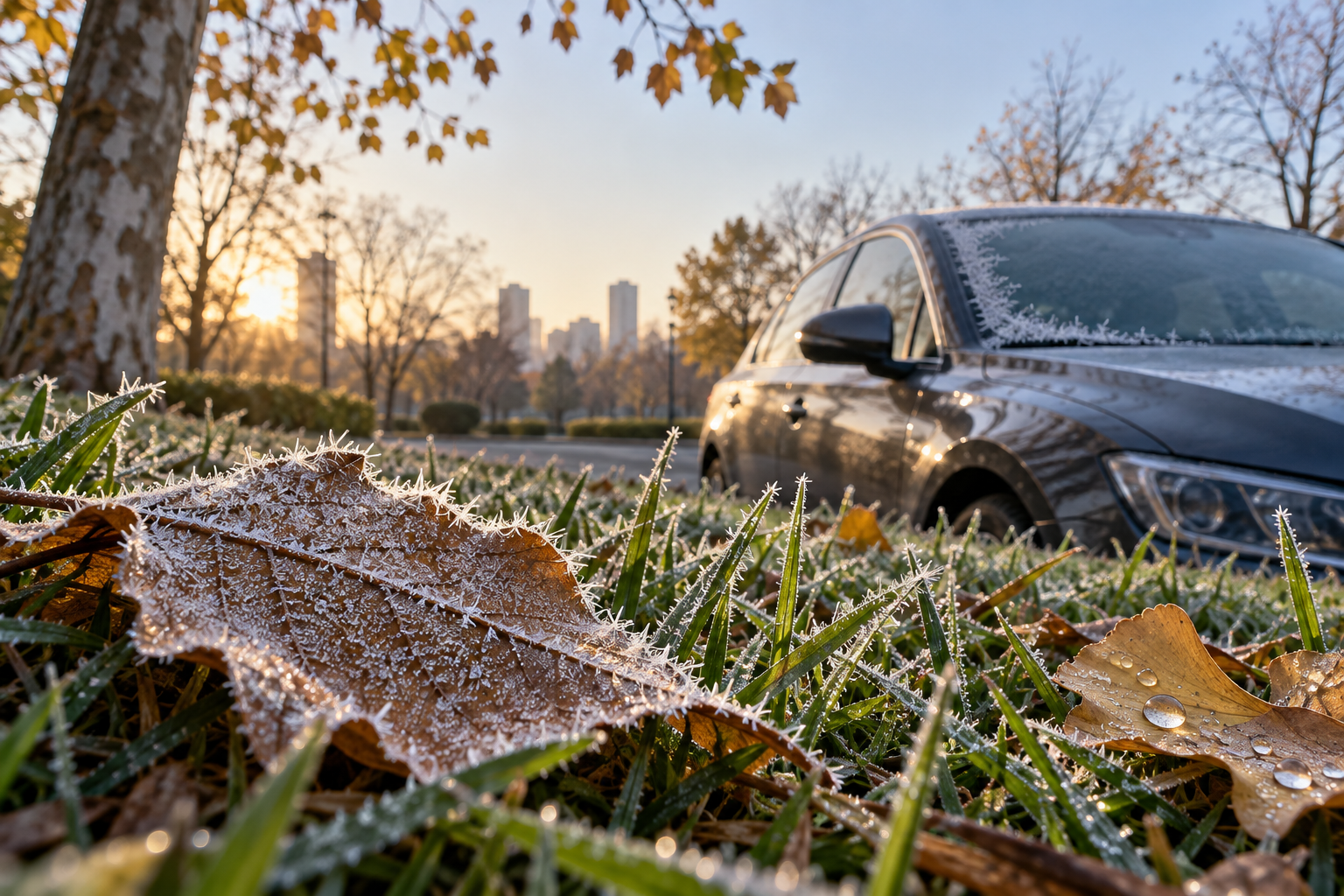
On clear nights with little cloud and light winds, the ground and exposed objects keep losing heat. The surfaces of grass blades, soil and the outside of car windows can all cool down. When a surface drops below zero degrees Celsius and the nearby moisture conditions are right, water vapor may form ice crystals directly on it through deposition.
This is why frost may already have formed on grass and outdoor car windows in the morning even when the forecast air temperature is still above zero. The forecast refers to air temperature; leaves and glass surfaces can be colder than the air. Feeling cold as you stand beside a plant does not tell you exactly how cold one of its leaves has become. Zhejiang Meteorological Service: how frost forms
Dew and frost are different, too. Dew consists of tiny liquid droplets, while typical frost consists of solid ice crystals formed directly by deposition from water vapor. Reading “The reeds grow thick and green; white dew becomes frost,” we can sense autumn deepening. But we cannot conclude from the poem that every layer of frost must first become dew and then freeze.
Ancient writers also offered different explanations. The Huainanzi says, “Qingnü then emerges, bringing frost and snow,” placing their arrival within a myth. Wang Chong of the Eastern Han dynasty, meanwhile, wrote in Lunheng, “They all arise from the earth; they do not fall from the sky,” seeking explanations for clouds, rain, frost and dew in nature itself. These two ways of understanding remain in different ancient texts.
Returning to “frost fills the sky” with this in mind makes the line more interesting. White frost clings to objects, while the poem's chill fills the night. Zhang Ji's riverbank maples, fishing lights and bells evoke the cold and sadness of a journey. Knowing how frost forms does not prevent us from understanding the poem.
Frost Descent has arrived. Why is there still no frost outside?
Frost Descent is the eighteenth of the twenty-four solar terms and the last solar term of autumn. It usually begins on October 23 or 24, when the Sun reaches an ecliptic longitude of 210 degrees. Its timing is determined by the Sun's position. China Meteorological Administration: Frost Descent
Whether frost forms where you live that day also depends on latitude, elevation, terrain and the current weather.
Many names of the twenty-four solar terms reflect climatic experience from the middle and lower reaches of the Yellow River. The farming saying “Frost appears at Frost Descent and ends at Grain Rain” needs to be understood in that regional context. Some northern places may already have seen their first frost while parts of the south remain warm. People in different places may turn to the same calendar page yet wear different clothes when they go out in the morning.
White Dew, Cold Dew, then Frost Descent: the names make fine distinctions as autumn moves from cool to cold. In ancient descriptions, the dew at Cold Dew “is about to freeze into frost,” while Frost Descent carries the sense of frost beginning. These are observations of the season's progression and need to be distinguished from the actual dates when dew and frost appear in each place.
Su Shi left a small account of seasonal timing from his life in Hainan.
In “On Chrysanthemums in Hainan,” he wrote that chrysanthemums in the north generally flowered with the progression of autumn, while in Lingnan they often did not bloom fully until winter. He grew chrysanthemums in Hainan and, in the eleventh lunar month, shared chrysanthemum wine with guests to celebrate the Double Ninth Festival belatedly.
The Double Ninth falls on the ninth day of the ninth lunar month, yet he enjoyed the chrysanthemums and celebrated in the eleventh month, after Frost Descent. Su Shi's short account makes the regional difference clear. The festival date had arrived, but the local flowers had their own flowering time.
There is nothing strange, then, about seeing no frost on the day of Frost Descent. The solar terms provide a shared reference for time, while the trees, flowers and vegetable patches near our homes still grow in their local weather.
City residents add a layer of clothing; growers also count the days
For someone without experience of farming, autumn's first frost may mean it is time to put on another layer. Growers have more specific concerns. What is still unharvested? Which crops are vulnerable to freezing? Will this cold spell arrive too early? All of these questions affect the harvest.
This brings us to the first frost, the last frost and the frost-free period.
The first frost to appear in autumn is called the first frost; the final one in spring is the last frost. The interval after the last spring frost and before the first autumn frost of the same year is a place's frost-free period. Its length is an important climatic factor in planning agricultural production, and it varies between places and years. China Meteorological Administration: the frost-free period
The farming year is organized around sowing, ripening and harvesting crops. For crops vulnerable to freezing, this interval matters when deciding whether to sow a little earlier in spring or wait until they are ripe before harvesting in autumn. But crops such as winter wheat can survive the winter, and farming can adapt to low temperatures by selecting varieties, adjusting sowing dates and using protective covers. The frost-free period matters, and so do a crop's cold tolerance and stage of growth.
These dates can also shift with climate change. A study using records from 83 weather stations in the Yellow River basin between 1960 and 2020 found that, over this period, first frosts generally occurred later, last frosts earlier, and the frost-free period lengthened by an average of about 4.5 days per decade. The seasonal experience recorded in farming sayings needs to be considered alongside the local weather in a particular year. A long-term average change cannot tell us which day this year's first frost will appear. Study of frost dates in the Yellow River basin
Ancient people closely connected cold weather with the organization of daily life. The “Monthly Ordinances” chapter of the Book of Rites records, “When frost first descends, the artisans cease their work,” followed by, “The cold has fully arrived; the people's strength cannot bear it. Let them all go indoors.” Autumn harvests, storage, construction work and living arrangements were organized around seasonal changes. These monthly prescriptions preserve the idea of arranging labor according to heat and cold.
The same chapter also records seasonal signs such as “plants turn yellow and shed their leaves” and “dormant insects all retreat.” Yellowing and falling leaves, and insects hiding away for the winter, were all noticed. Today, in a park or along a field path, we can still look at how far the local plants have progressed through the season. Even without frost, there are other changes to see.
Today, living in air-conditioned rooms can make us a little less sensitive to outdoor temperatures, while plants in the fields still face each drop in temperature directly. A cold-sensitive plant on a balcony can make that difference easier to understand. We can put on clothes or go indoors; whether a plant gets through a cold night depends on its own cold tolerance and its surroundings.
Do “frost-struck eggplants” and “frost-touched greens” describe the same outcome?
The familiar Chinese expression “like a frost-struck eggplant” describes someone looking wilted and dispirited. Yet when we buy vegetables, we may hear another saying: frost-touched leafy greens taste sweeter.
Why can the same cold produce such different results?
First, we need to distinguish frost from frost damage.
Frost consists of ice crystals on the ground or on objects near it. Frost damage involves injury to plants from low temperatures. Sometimes leaves have a layer of white frost and the plant is still fine; sometimes the air is dry and no white frost is visible, yet the plant has already suffered freezing injury. The latter situation is also known as “black frost.”
The extent of the damage also depends on how low the temperature falls, how long it lasts, the crop and its stage of growth. Looking only for a white coating of frost cannot tell us whether a plant is safe. China Meteorological Administration: frost damage
The saying “frost kills all the grasses” brings severe cold and visible white frost together. When water vapor forms ice directly through deposition, it releases heat, which may affect local cooling. But this does not mean white frost can be treated as a protective layer, nor can black frost and white frost simply be assigned a fixed order of danger.
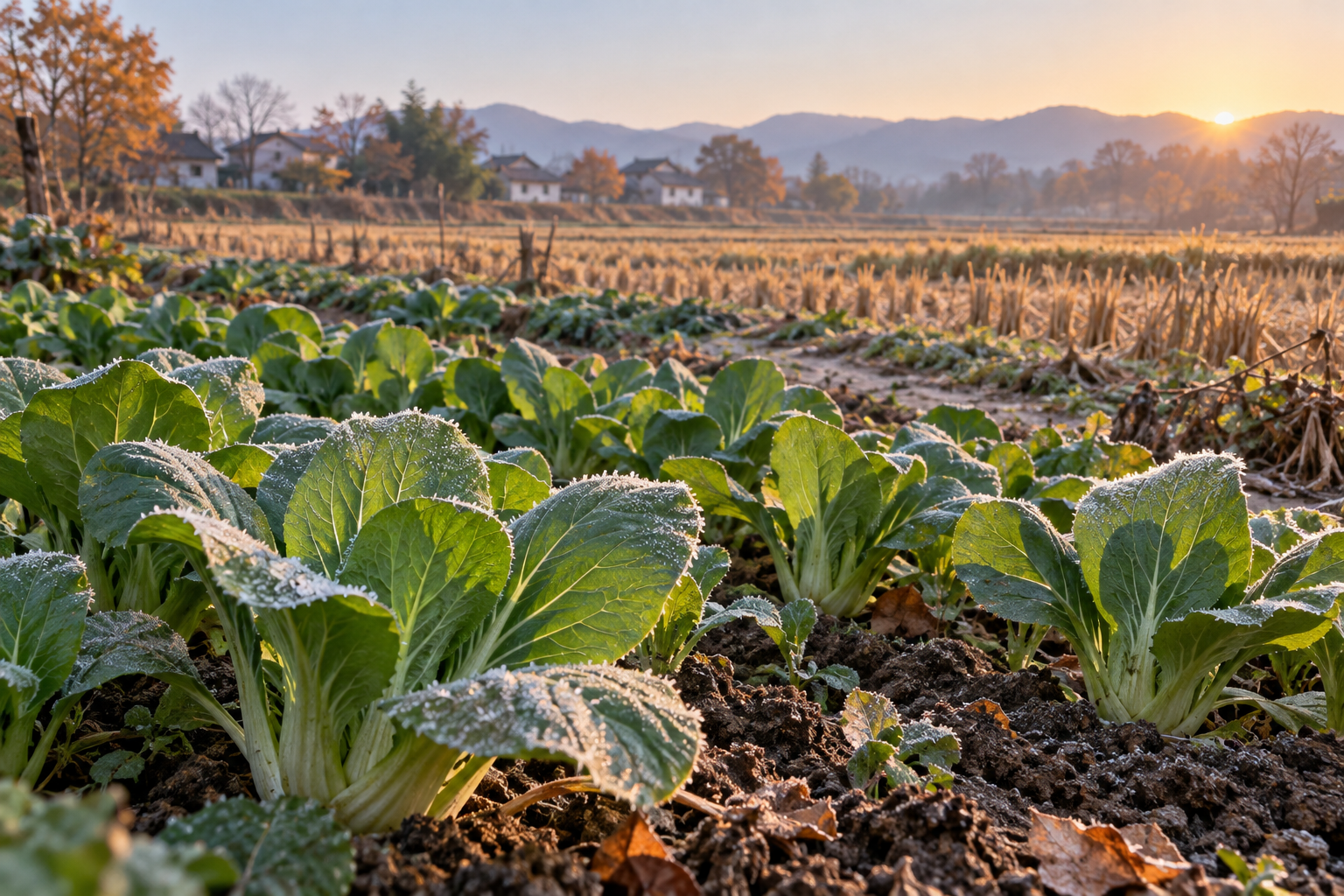
The sweetness of leafy greens is connected with the way some cold-tolerant vegetables adapt to low temperatures. In moderately cold conditions, starch within them can be converted into soluble sugars, changing their taste and helping them resist the cold. Tomatoes, peppers and green beans are less cold-tolerant; freezing can leave them wilted or shriveled and reduce their quality instead. China Meteorological News: why frost-touched vegetables can taste sweeter
So when a vegetable seller mentions “frost-touched” greens, we can think of the changes in taste brought about by moderately cold conditions. If a potted plant at home has wilted leaves, we should also consider whether it has suffered freezing injury. We need to look at visible frost, the weather and the type of plant together. Leaving vegetables exposed to freezing for longer in pursuit of greater sweetness is not appropriate either.
Some hope for warmth, some for a harvest. Frost Descent can be lively, too
Familiar poems often connect frost with autumn's desolation.
“The autumn wind sighs; the weather turns cold. Plants shed their leaves, and dew becomes frost.” In Cao Pi's line, cooling weather and falling leaves form one autumn scene. The Songs of Chu also says, “Autumn first warned me with white dew; winter repeated the warning with harsh frost.” Dew and frost seem to bring successive messages of approaching cold. Expressions such as “weathered by wind and frost” and “wind like knives, frost like swords” carry this bodily experience of cold into people's trials in life.
Ancient ideas of yin and yang associated frost and snow with yin, and gave different meanings to nourishing dew and severe frost. These understandings reflect both lived experience and imagination. In literature, we can follow them into the feeling of late autumn; when judging whether a plant has suffered freezing injury, we need to return to actual temperatures and growing conditions.
Late autumn also has another side.
In Xiangdu Town in Tiandeng, Guangxi, the Frost Descent Festival is connected with life after the harvest. Antiphonal singing, rituals and market trading bring people from the surrounding area together. Research on the festival describes farmers trading their surplus produce for farming tools and everyday supplies. Research on the Zhuang Frost Descent Festival
After a busy spell in the fields, people meet again at the market. This Frost Descent has the liveliness that follows a harvest.
In Miscellaneous Notes Aboard a Boat, Wang Mian wrote, “Heavy dew chills the flowers' fragrance; at Frost Descent, crab fat is rich.” The poem contains cold, slanting light, water and bamboo, but also the pleasure of buying wine and looking at the mountains. The cold is deepening, and food has taken on the flavors of the season.
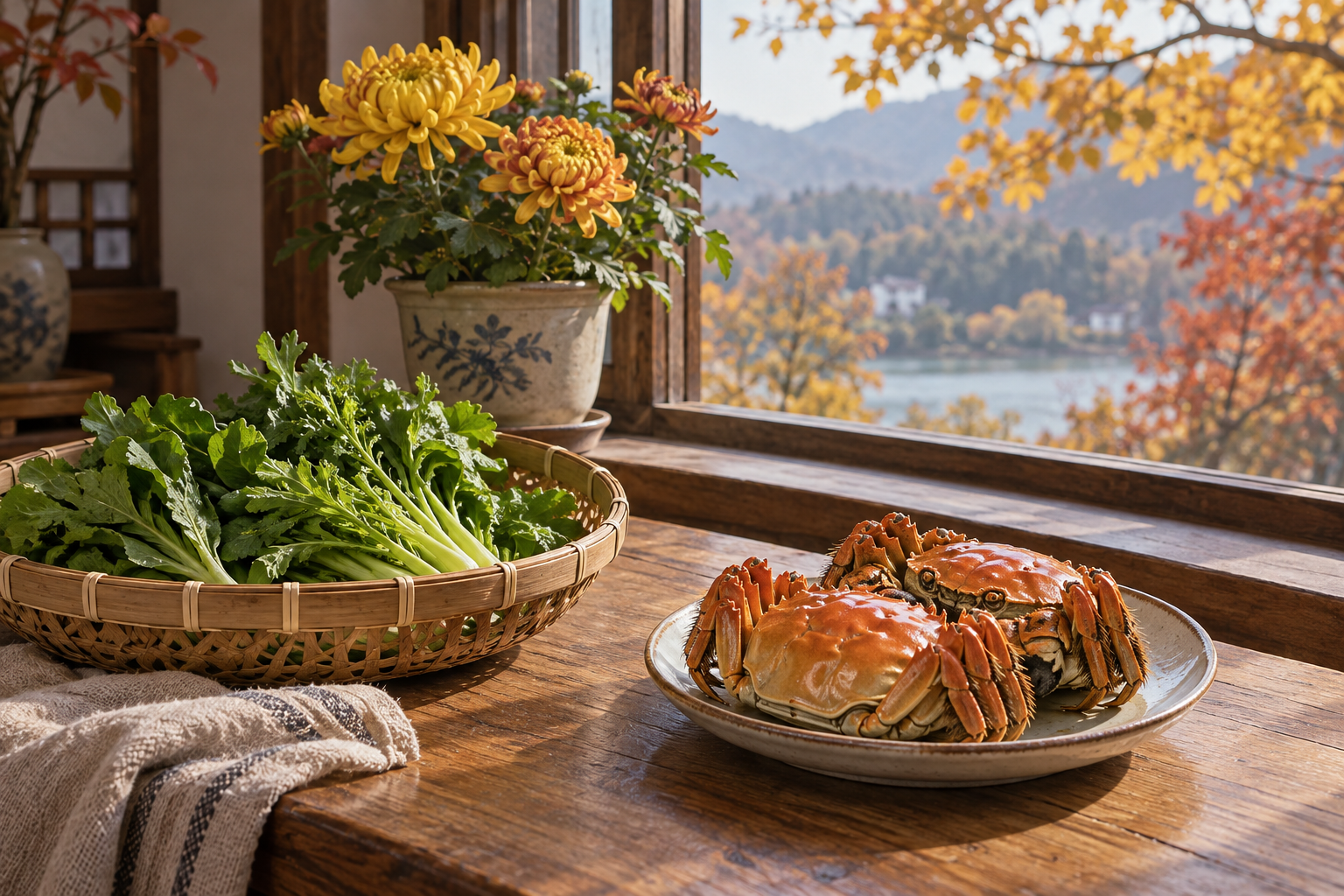
Of course we can feel a sense of quiet at Frost Descent, and we can also keep going to markets, enjoying flowers, cooking and heading out to look at the trees. Scenery differs between north and south, and each person has a different relationship with the season.
In city life, understanding the solar terms can begin with small things. Walking past a patch of grass in the morning, notice whether the white on it is dew or frost. When buying leafy greens, ask where they were grown and how they taste this season. When the forecast mentions falling temperatures, think about the plants outside the window, too.
As for “The moon sets, crows cry, and frost fills the sky,” the poem's night will remain moving when we read it again. We will also know that after a cold night like that, there may be frost on the morning grass, someone in the fields thinking about the harvest, and some leafy greens slowly growing sweeter.
What did this bring to mind?
Share a memory, a different view, or a thought you would like to continue. No account is needed. Comments appear after review; readers’ words remain in their original language.
Leave a comment
Conversation
Loading comments…