
I've been posting daily collections of paintings on my WeChat official account for around seven or eight hundred days. I don't remember the exact number. There are also the earlier collections I made from time to time to count.
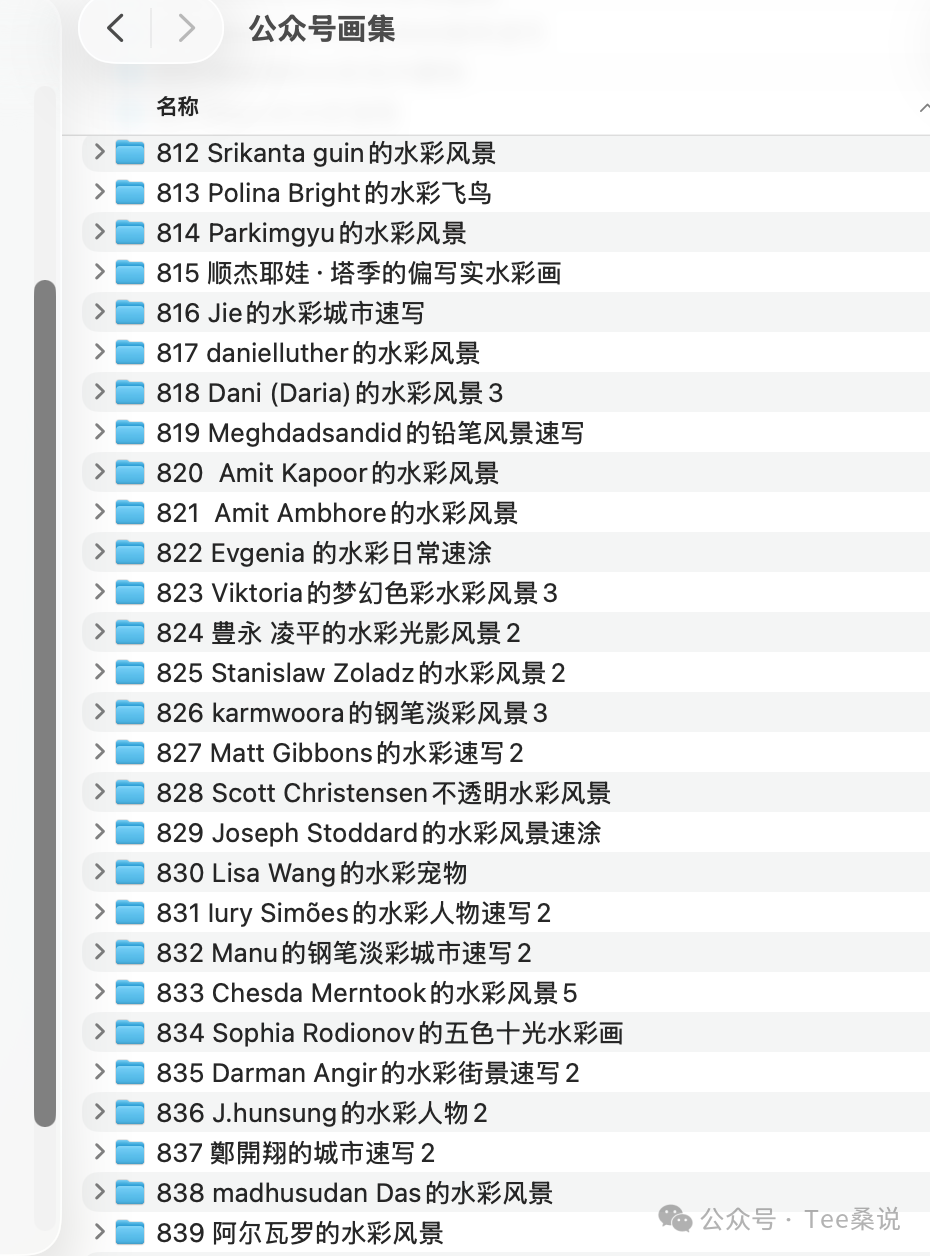
Calling it perseverance doesn't feel quite accurate. Since I collect paintings I like, the act itself is enjoyable.
A few days ago, I also posted about several principles I follow when collecting. The first is simply that I like it. If a painting's style or color combinations appeal to me, then I want to collect that artist's work. I respond to the image itself. Often, I can't even remember who painted which piece, but I like the picture.
I know choosing famous painters might bring more traffic. But when collecting, I still begin by asking whether I like the image.
That's why some people appear repeatedly in my collections. After half a year or a year, I return to their work to see whether their style has changed. Sometimes I also want to know whether the same things still attract me after time has passed.
Beyond liking it, there's a very practical criterion: given my current ability, can I use these paintings to copy and learn from?
Some paintings are striking, and I want to look at them longer, but I may not understand how they were made. With others, I can understand them, but my own fluency isn't at that level. The work of painters such as Joseph, Chien Chung-Wei, and Alvaro has that distance for me.
Between understanding and painting it myself, there is still a lot of practice to do.
In the paintings I collect now, I give more thought to whether I can get started. Sometimes I want to pick up a brush without spending too much effort devising a picture. I open a collection, choose a few paintings, and can start copying straight away. How it turns out is a later question. At least I don't stay stuck on what to choose or where to begin.
That's also why my collections carry such obvious personal preferences. They contain both what I like and what I can use at my present stage. A painting's absence doesn't mean I think it's bad.
Recently, while discussing the knowledge needed to approach art, one idea struck me.
“Understanding and liking can be separate.”
Thinking about my own experience of looking at paintings, that really is true.
I studied art history before, and later went on an art study trip to Italy. Seeing some original works was truly astonishing. Especially with oil paintings, standing in front of the original and looking at the brushstrokes made them feel so vivid and alive. I'd never experienced that from digital images.

Then, after reading interpretations online and learning some historical background, I returned to the painting and felt something different again. The brushstrokes in front of me, stories I'd read, and my understanding of that period of history came together.
So the experience of looking at a painting can be quite layered.
But even with that understanding, I don't necessarily like the painting.
I can understand why it matters and feel the vividness of the original. Whether it's something I want to look at repeatedly or collect returns to my own feelings.
Today's discussion also mentioned a study. In 2023, researchers had 30 university students who were not art majors view works in a museum, comparing the effects of labels with different levels of detail. More detailed descriptions helped understanding and increased viewing time, but no significant improvement was found in aesthetic appreciation of the works.
The sample was small, so it cannot establish that learning about a work will never make people like it more. It only shows that, in this experiment, understanding more didn't simultaneously become greater appreciation. To me, that distinction is worth noticing.
As for where liking actually comes from, I can't quite explain it either.
It may be color or texture, or something that resonates with me. Liking a painting doesn't necessarily require knowing the artist or the background of the subject first.
And liking has a time element too.
I may not like in the future what I like now. Some paintings feel particularly moving within an exhibition space; once I leave, I may not think about them so much. I may love one on its own, then discover I prefer another when they are placed side by side.
That doesn't necessarily mean the work has changed. The viewing environment, the works around it, and my own state at the time can all contribute to the feeling.
So if I say in the future that I want to do something to make art easier to understand, I hope I can be more specific.
For example, when sharing a painting, I can explain why I stopped to look, and what attracted me in its color, brushwork, or handling. If I want to learn from it, where can I begin, and what can't I do yet?
Following those observations, someone else may see a little more. Whether they like it afterward can remain their own decision.
“Some works I like more after learning about them. With others, I understand, but I still don't like them that much.”
Both can sit there for now. There's no rush to pass judgment on my own feelings.
I'll keep collecting. In half a year or a year, when I return to the same painter, I'll also see which paintings the person I am then has come to like.
If you'd like to find some paintings to look at slowly, you can browse the earlier collections on this WeChat official account. Choose one you like first, and see whether it's the color, brushwork, or something else that attracts you.
“Start with a painting you like, and see what draws you to it.”
Research source: Psychophysiological and behavioral responses to descriptive labels in modern art museums, PLOS ONE, 2023.
The views, experiences, and final judgments in this article are the author's. AI assisted with organizing the text.
What did this bring to mind?
Share a memory, a different view, or a thought you would like to continue. No account is needed. Comments appear after review; readers’ words remain in their original language.
Conversation
Loading comments…