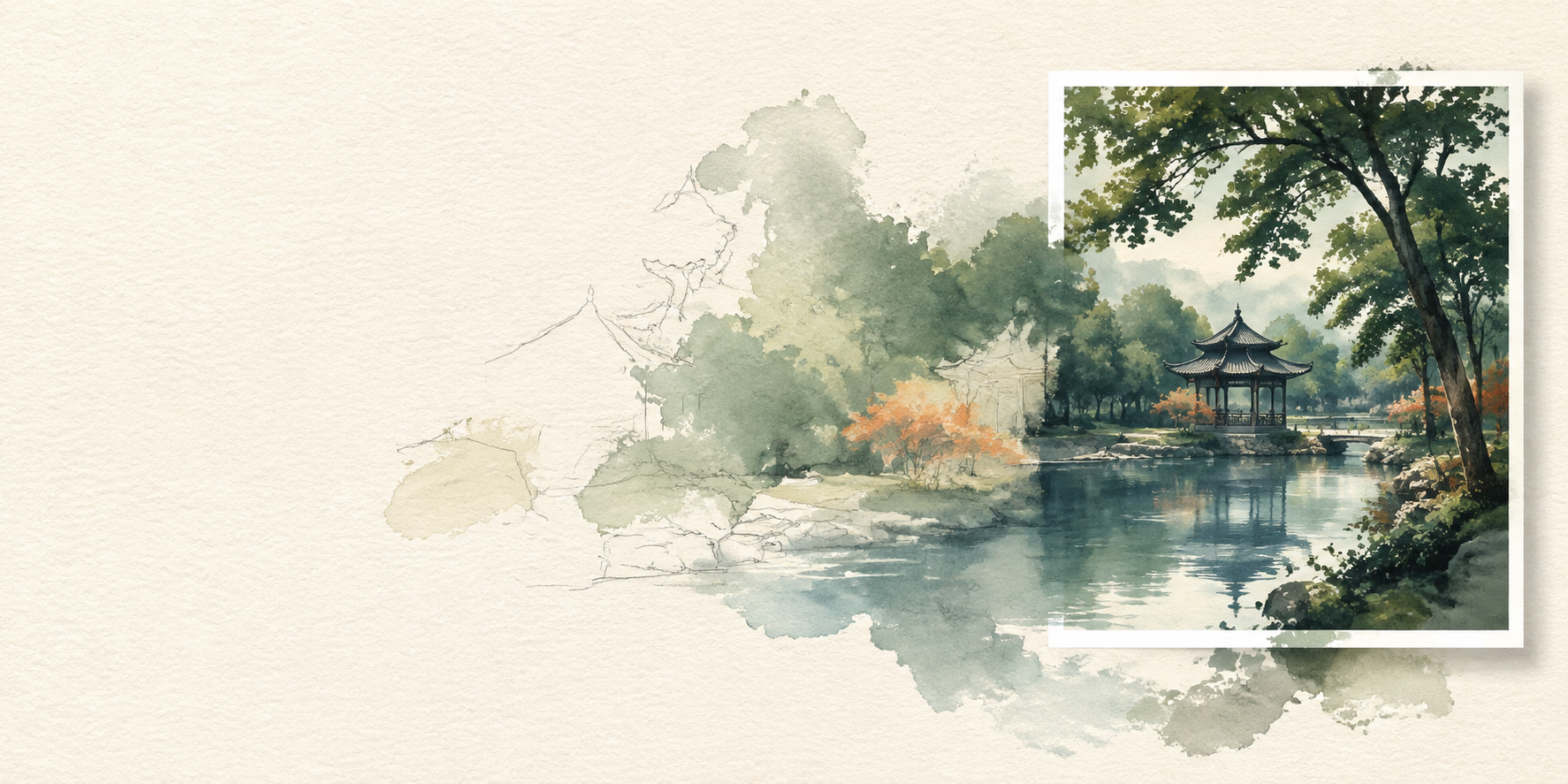
A question appeared in the dashboard of Ask Tee Sang: why does copying a photograph go so smoothly, yet the moment the photograph is taken away, I have no idea what to draw?
Many people put this down to imagination.
They feel they have no pictures in their head and cannot create something from nothing, so they have to rely on photographs. But after more than ten years of painting watercolors, I increasingly feel that imagination is taking rather more than its share of the blame.
With a photograph in front of you, you feel that you can draw. But how much of that feeling belongs to you, and how much is on loan from the photograph?
When a photograph is in front of you, some important decisions have already been made on your behalf.
Where the image begins and ends, the proportions between objects, the direction of the light, how near and distant things overlap, and even which patch of color stands out most have all been fixed inside a rectangle by the camera.
All we need to do is gradually move those shapes, tones, and colors onto paper.
Take the photograph away, and those questions suddenly return to our hands. Which part should I draw? From what angle? Is that a tree, or a group of shapes in different tones? With so much in front of me, what stays and what goes?
It is quite normal for your mind to go quiet all at once.
That silence does not mean your mind is empty. It means it has suddenly realized that all the decisions someone else used to make for it are now its own responsibility.
This does not necessarily mean you lack imagination. It is more like a reminder that you have practiced following an existing image more than you have practiced organizing an image yourself. The second skill simply is not yet as fluent.
01 The photograph has already organized the world for you once
In other words, before a photograph helps you draw, it has already helped you look.
Photographs are useful. I often paint from them myself.
They preserve fleeting light and let us study an unfamiliar scene at leisure. They also provide a steady reference for practicing color combinations, brushwork, and control of materials. They will not walk away, suddenly change pose, or start raining just as you finish mixing your colors.
But a photograph is not unprocessed reality.
At the instant the shutter is pressed, the photographer has already chosen where to stand, which focal length to use, what to keep, and what to leave outside the frame. Real space has also been flattened. What we later face is an answer that has already passed through one round of selection.
Copying that answer can train hand-eye coordination, color judgment, and technique with materials. But another ability may not develop alongside them: do you truly understand the things in the image, and can you organize them again yourself?
For example, you might copy the light, shade, and colors of a tree very accurately. But change the viewpoint, or try to draw it with just a few lines, and you may suddenly be uncertain about the relationship between the crown and the branches.
What is missing then is not imagination, but an understanding of form, visual memory, and experience in deciding what to keep and what to leave out.
02 There is a distance between copying well and working without a photograph
These abilities overlap, of course, but they are not interchangeable.
With a photograph, we are mainly solving a problem of translation: how to turn the two-dimensional image we see into lines and colors on paper.
On location, there is more to do.
The light changes, people move, and leaves blow in the wind. What our eyes can see extends far beyond a sheet of paper. We have to cut an image out of continuously changing reality, then decide what is worth keeping.
Drawing from memory or imagination takes another step. We need to know roughly how something is put together, remember its more stable features, and recombine things we have seen before.
Imagination does not mean a city you have never seen suddenly appearing from nowhere in your head. Often, it means you have finally seen enough and understood enough to be able to rearrange what you know.
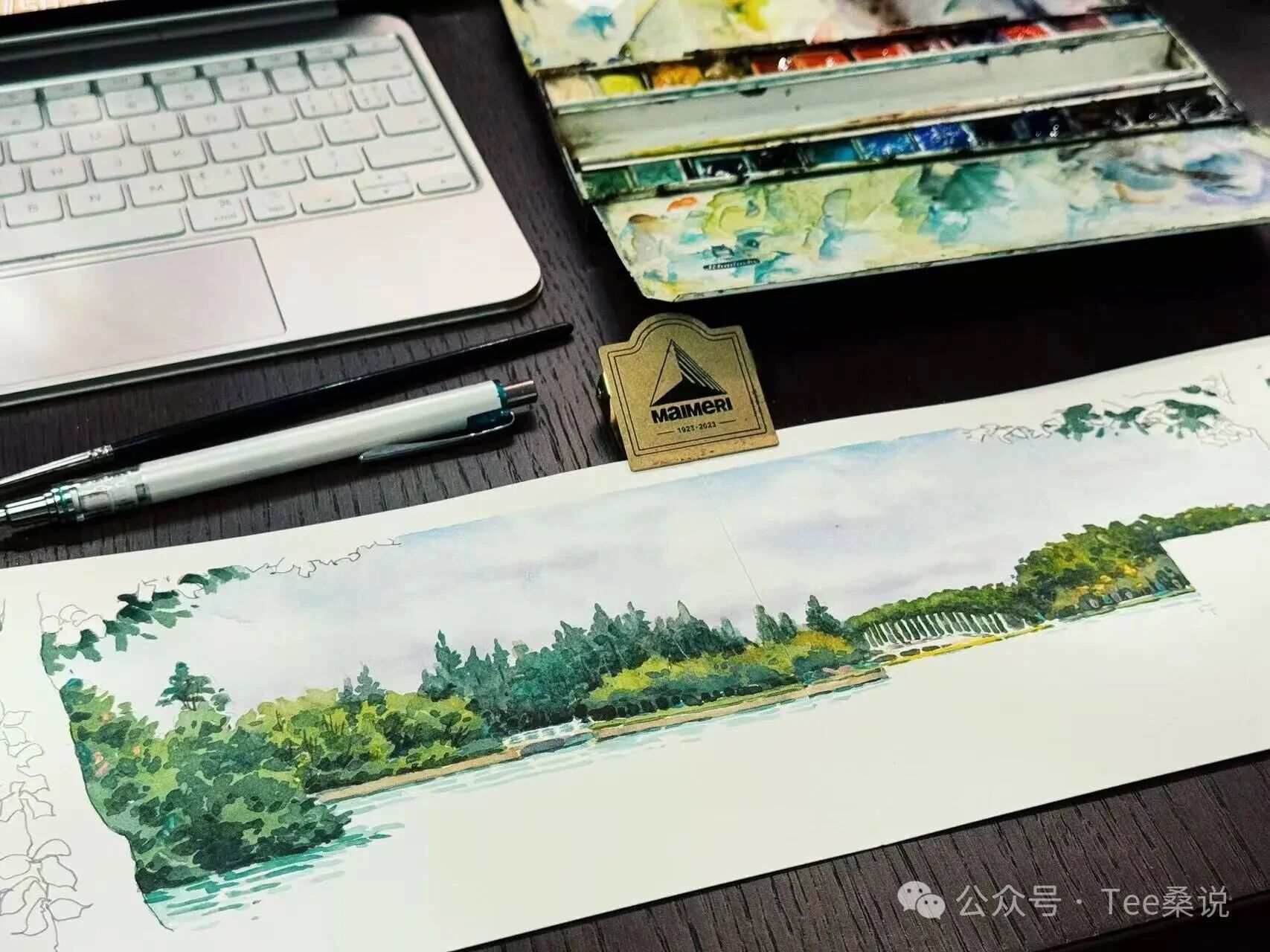
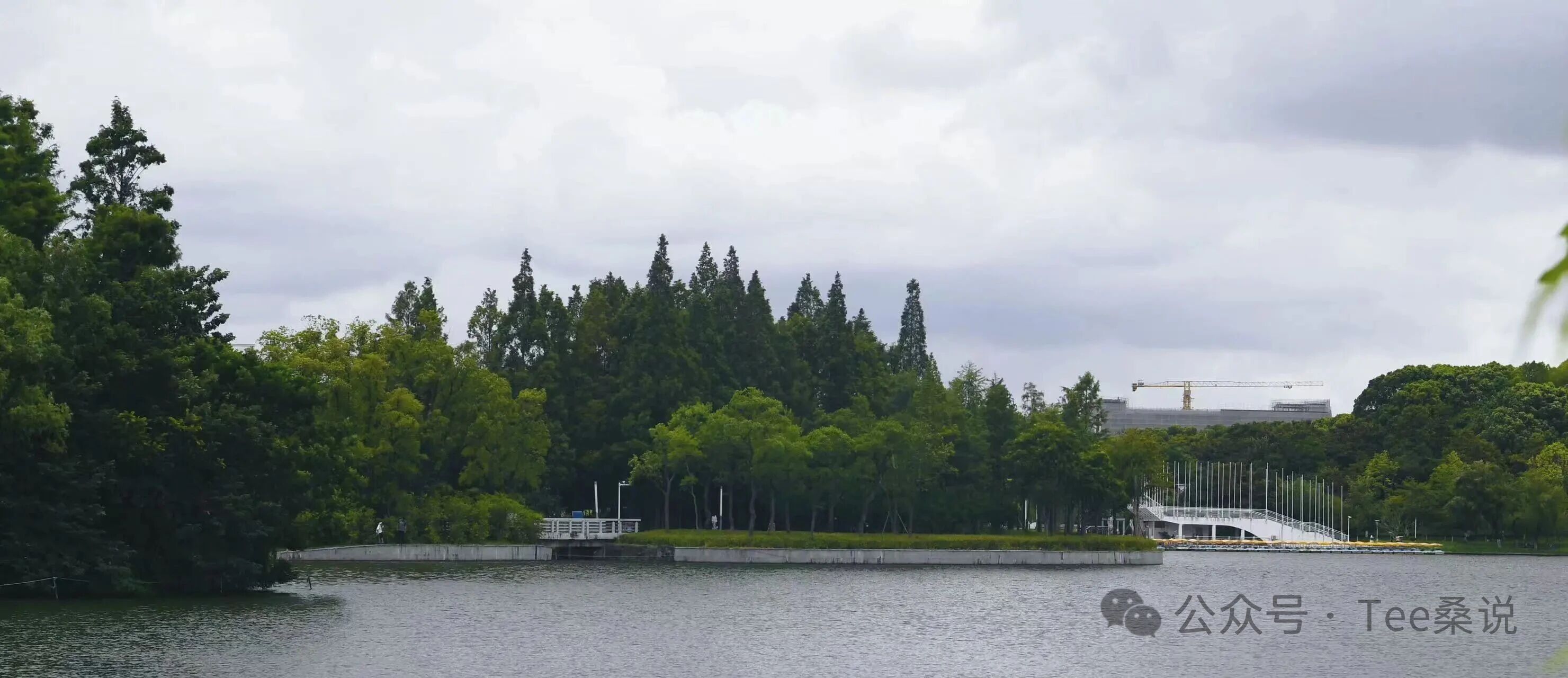
Most of my watercolors in recent years have had something of the sketch about them. I often keep a painting to between 40 minutes and an hour. With so little time and a scene that keeps changing, I cannot wait for every leaf to strike the right pose.
I have to see trees as a few large masses, reduce buildings to a few structural lines, and turn distant people into spots of color. As I paint more, my own habits of handling these things gradually stay in my mind. When I meet similar trees, houses, and water again, I do not have to start from zero every time.
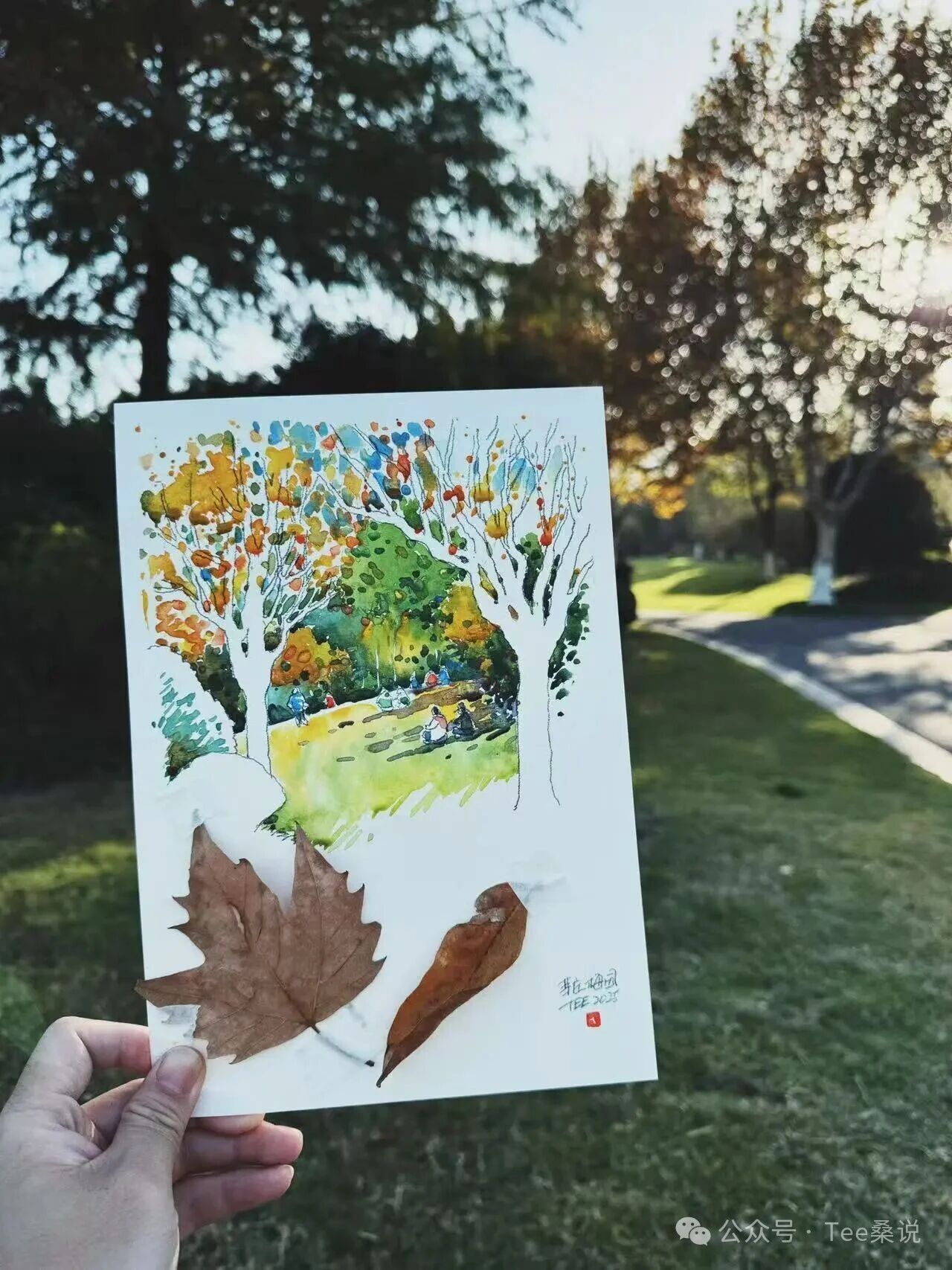
These habits may look like style, but underneath, they are a visual vocabulary.
Can you suggest the mass of a tree in three strokes, or can you only describe it leaf by leaf? That is a difference in vocabulary.
With a small vocabulary, it is natural to run out of things to say when the photograph goes away. Writing is much the same.
Take away the reference article, and a person does not suddenly lose their thoughts. What they have read, thought about, and can actually call upon simply have not yet connected.
03 First, work out why you want to leave the photograph behind
Before discussing methods, there is something to think through.
If you simply enjoy copying, find the process calming, and feel satisfied with what you finish, there is no need to diagnose "dependence on photographs" as a condition that needs curing.
Painting does not require everyone to end up creating from thin air. Copying, drawing from life, and painting from imagination train different parts of the process.
The situation that does need attention is when you already want to sketch outdoors, paint real life around you, or make some changes of your own to a photograph, but find that without the reference you cannot even decide where the first stroke should go.
Then, instead of blaming a lack of talent or imagination, make the question smaller:
Am I familiar with how this thing is put together? Can I describe it with a few large shapes? Do I remember the object itself, or only the light and shadow on the surface of the photograph? If I could keep only three things, what would they be?
Those four questions are a way to check how far your understanding of form, visual memory, and experience of selection have developed.
With practice, a layer of your own judgment will gradually form between your hand and your eyes.
04 There is no hurry to give up photographs completely
Some people discover that they rely on photographs and immediately decide that, starting tomorrow, they will use no references at all. They force themselves to draw from memory, imagine, and be original.
There is no need to be quite so hard on yourself.
You can keep using photographs. Just ask them to step out for a while during practice. The following small exercises are more practical than suddenly announcing, "I will never look at a photograph again."
Draw with lines alone for ten minutes
Find a cup, a potted plant, or something you can easily see beside the window.
Leave the colors aside for now, and do not rely on heavy shading for effect. Use only lines to work out the contours, changes of direction, proportions, and overlaps. The simpler the lines, the easier it is to see uncertainty in your understanding of form.
It is fine if the drawing is not good. This exercise is not homework to be handed in. It is a way to see what color normally covers up for you. Afterward, look at the part you felt least sure about. That is a gap in your understanding of form.
Look for three minutes, then cover the photograph
If drawing with lines alone still feels difficult, reverse the process: let the photograph help you for a while, then ask it to leave early.
Choose a fairly simple photograph. Look at it for three minutes, then cover it.
Do not aim for completeness. Draw just the three to five large shapes you remember and where they sit in relation to one another. Then uncover the photograph and compare.
Not everything you left out is necessarily a problem. Something may have gone unremembered because it was not important to begin with. Pay closer attention to the parts you thought you understood but could not describe at all once the photograph was covered. Those are blind spots in visual memory.
After copying, deliberately change one condition
The first two exercises subtract something: color, then the photograph. The third goes the other way, adding a little of your own to a copy.
After completing a copy of a photograph, make another, very small version.
You could change the crop, turn daytime into evening, or keep only two or three colors. Change just one condition at a time. There is no hurry to prove how rich your imagination is.
The first time you deliberately change a decision within the picture, you have already begun to create.
I remember once copying a photograph of the Bund. When I finished, the composition felt too crowded, so I painted a small version beside it. I reduced the space for the sky, left more room for the water, and kept only the outlines of three buildings. The moment I changed it, something felt different. The first painting had been answering a question the photograph posed. In this one, it felt as though I was asking a question myself.
I would not call it a breakthrough. But it was the first time I clearly felt that the photograph was no longer making every decision for me. What grew in that moment was not technique, but experience in choosing: knowing what to keep and what to let go.
05 The photograph can still stay beside you
It just will not make every decision for you anymore.
Next time you practice, there is no need to throw the photograph away. Look at it for three minutes, then let it leave five minutes early.
Perhaps in those five minutes, you will discover for the first time that you do have something to say. Until now, someone else has always rushed in to answer for you.
This article grew out of a real question submitted to Ask Tee Sang. If there is a specific problem that keeps stopping you while copying, drawing from life, or practicing, you can ask me through the mini program too. I may not have a standard answer straight away, but I can dig out some of the stumbles I have made over these years of painting and look with you at where the difficulty actually lies.
The views, experiences, and final judgments in this article are the author's. AI assisted with organizing the text.
What did this bring to mind?
Share a memory, a different view, or a thought you would like to continue. No account is needed. Comments appear after review; readers’ words remain in their original language.
Conversation
Loading comments…