After some students have shown me their paintings a few times, I feel they could probably guess what I'm about to say.
The same problem appears again in the next painting. But that doesn't necessarily mean they didn't listen. Sometimes they already know what isn't quite right, yet as they paint, their hands fall back into familiar habits.
At that point, how much help is it if I repeat myself? This is something I consider when critiquing paintings, and a question I've kept thinking about recently while building an AI painting judgment library.
At noon on September 3, I listened to Wang Runyu's livestream. He talked about turning what you know into a tool other people can use directly. I thought of Ask Tee Sang, which I've been refining.
Previously, I had made a mini program demo where you upload a painting and let AI analyze it. The feature can be built, but one question can't be skipped: why did the person make this painting, and why are they showing it to you?
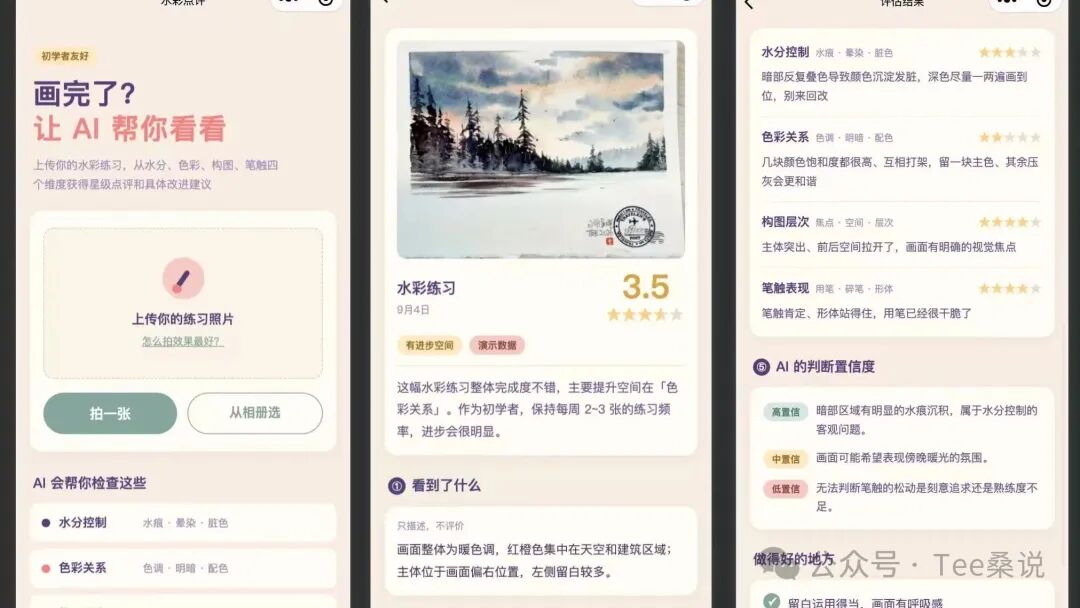
To get painting advice from AI that fits you better, you need to provide more than the image. Tell it your purpose, what you've been practicing, and the help you want this time. Without that background, even a human can critique the wrong thing.
When I look at a student's painting, I first try to understand the circumstances in which they made it. Are they stuck on a technique and wondering how to adjust it? Or have they finally finished a painting and simply want to share it and receive a response?
Painting is itself a form of expression. When someone shows you a painting, it's a little like their willingness to tell you what's on their mind.
"You can't decide whether a sentence sounds good before you've understood what they're trying to say."
At the very least, respect what they've already expressed, then find out how they want you to take part.
This is especially true for beginners. If they've only made a few paintings, inaccurate shapes are normal. They may already see that themselves. Tell them once more, "This part doesn't look like the subject," and then what? They still don't know what to do next.
I'm more interested in how they looked at the subject and how they put it down on paper. Did they miss a relationship while observing? Or did they see it, but their hands can't yet do what they want? Those call for different kinds of help.
If I've pointed out the same issue several times, I sometimes suggest trying a different subject or a different way of painting. When you keep painting familiar things, your hands tend to follow their old habits. A new subject may make you pause, observe again, and try a slightly different movement. There's no guarantee it will work immediately, but we can see whether anything changes.
And some things that look "wrong" may not need correcting at all.
Why can't the sky be red? Why must the relative sizes in a painting follow what we normally see? If this is how the painter wants to express something, imposing a set of realistic standards may erase their meaning. If they were trying to create a sense of space but don't know what's gone wrong, then we can discuss that specifically.
So I need to know their original intention before I can better judge whether what I see is what they wanted or something they haven't yet managed to achieve.

ins@5.eugengorean
Many people also show me paintings simply because they want a little encouragement. They've just started, they're willing to pick up a brush, and they're willing to share their practice. I think that alone deserves encouragement.
That's how I started too. Back then, I kept sharing my experience of learning to paint on Sina Weibo. Later, people asked whether they could learn with me, and I began offering classes in response to that need. When I first shared my work, I hadn't planned to offer teaching services one day. So even now, I encourage people to share without waiting until they're very good.
If you get halfway through a painting and don't want to continue, you can first ask yourself: did I mainly want to enjoy painting today, or practice a particular technique?
If you only wanted to paint for a while and relax, but every revision makes you more frustrated, stopping isn't a bad choice. If you've already added color before discovering that the shapes are wrong and changing them would take too much, you can start another painting. If it was a technique exercise from the beginning, note where you got stuck and what you specifically want to try next time.
There's no need to turn reflection into homework too. Keep the painting and look at it again later to see what's changed and what still needs practice.
"I'm reluctant to call all the time spent on an unsuccessful painting wasted. Your hand held a brush, touched the paper, watched color move through water. That process has already happened."
If you'd like to discuss your painting with a teacher or AI, try saying a little more the next time you send an image. If you don't know where to start, use this example and replace it with your own situation:
I've just started learning watercolor. This time I wanted to practice light and dark, rather than make it look especially realistic. At this point, I feel the subject doesn't stand out enough, but I've already added color and don't know whether I should keep changing it. Please ask about my situation first, then give me one thing I can try next. You don't need to list every problem at once.
If you only want to share the happiness of finishing a painting, you can say that directly too. After receiving advice, see whether it fits your original purpose. You don't have to follow every suggestion.
These are also experiences I want to put into the Ask Tee Sang painting judgment library. It should cover more than technique: what to ask first, when to give advice, and when not to rush to a conclusion. AI can help organize and draw on these experiences, but it cannot determine your creative motives from an image alone.
The mini program is still being refined. If you're learning to paint and want to try it with your own specific questions, you can visit the Ask Tee Sang mini program. If you'd like a longer trial, you're also welcome to message me privately to apply for the beta group. We'll discuss the arrangements in private messages.
When you use it, tell me which answers helped and which failed to understand what you meant. Those specific responses are what will show me where to make changes next.
The views, experiences, and final judgments in this article are the author's. AI assisted with organizing the text and generating illustrations.
What did this bring to mind?
Share a memory, a different view, or a thought you would like to continue. No account is needed. Comments appear after review; readers’ words remain in their original language.
Conversation
Loading comments…