Someone left this question in the Ask Tee Sang mini program: how can I get better at simplifying a picture? When facing a photograph, which things should I paint, and which can I leave out?

It looks like a question about technique, but it already touches on something important in painting: the point at which you stop copying the subject and begin deciding what you want other people to see.
A sheet of paper cannot hold the whole world
Much of my watercolor practice in recent years has had something of the character of sketching.
Whether I'm out painting on location or painting from a photograph, I usually keep a piece to between 40 minutes and an hour. Apart from pet commissions, which sometimes take two or three hours, I rarely spend a very long time laboring over one painting.
That amount of time naturally forces you to subtract.
Outdoors, the light changes, people move, and the wind won't stop to wait for you to finish. Even with a photograph, the paper is only so big. You're unlikely to fit in every leaf, railing, window, stone, and reflection on the water without leaving anything out.
Of course, there is nothing wrong with rich detail. Hyperrealism is another creative choice in its own right. But when we're making a watercolor in around an hour, the question changes: what is worth keeping?
In a photograph, the leaves are important, the windows are important, and so are the stones on the ground. Once everything is important, viewers often don't know where to look.
What I left out in Fuxing Park
I made this painting in Shanghai's Fuxing Park, in about an hour.
There was actually a great deal of information in the scene. Stones and the water's edge in the foreground, reflections in the water, trees with a strong mass around them, and a pavilion, railings, and other built structures behind.
But what drew me that day was the rich color of the trees, and the way they overlapped in depth and varied in height.
So on paper, I didn't chase after every single thing in front of me.
I grouped the orange-yellow, yellow-green, and deep green into several large areas of color. I left out much of the foreground stones, water reflections, and large trees around the edges. The architecture didn't vanish completely; I left faint lines and a little structure so it could sit quietly behind the trees.
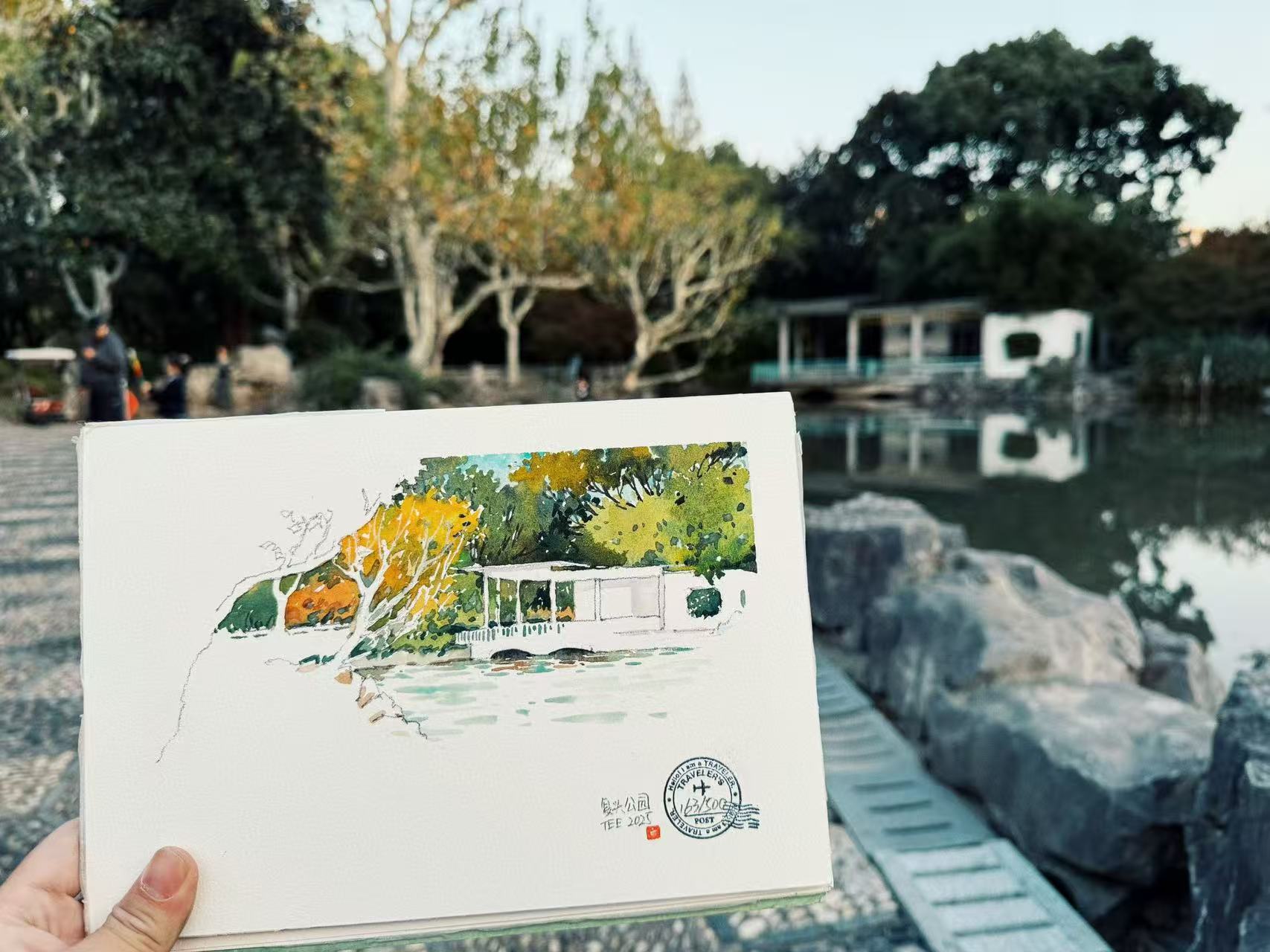
I'm quite pleased with this painting.
It certainly doesn't record Fuxing Park in full, but it keeps what I truly wanted to paint that day. The things that didn't make it into the picture weren't there for nothing. They simply, very politely, gave up their seats to the trees.
Painting sometimes needs a little hospitality too. Not everyone can sit at the main table.
What to subtract depends on a thing's role in the painting
When people hear “simplify,” their first thought may be to paint less.
But if you paint a little less everywhere equally, the picture may still lack a focus. Making real choices requires deciding first what is the subject and what supports it.
For example, when facing a group of trees, I usually don't focus on individual leaves. I first see the canopy as a large volume, sometimes almost spherical, sometimes a basic geometric form. Then I distinguish the lit surface from the shadow, and use warm and cool colors, lighter and darker values, and varying heights of shapes to separate the layers in depth.
If the trees are only a background for architecture or a person, they don't need to compete for attention. You can add a little more to the subject while reducing the contrast, color, sense of volume, or degree of finish in the supporting elements.
If the main character of this painting is a tree, the details can naturally be distributed differently.
So what really determines addition and subtraction is the role a thing plays in this particular picture.
Simplification starts before the brush touches the paper
When I look at a scene or a photograph, a rough sense of a picture usually appears in my mind first.
Sometimes it comes from a familiar way of expressing things; sometimes it's a new experiment. For example, if I've recently collected a watercolor style I like, I'll first work through its colors and methods, then bring some of them to a new photograph or an outdoor scene.
When I actually begin, I generally start with a pencil sketch. For pen-and-wash work, I'll add a few appropriate ink lines. Next, I decide how much white paper to leave or whether to cover most of the sheet. I begin with the sky and distant scene, move from far to near and from large forms to smaller ones, gradually reduce the water from the wetter early stages, and consider details last.
This is a personal route I've developed through painting a lot. It isn't a standard sequence every watercolor has to follow.
But it does show one thing: simplifying doesn't happen only when you remove details. When you decide what colors, brushwork, and process to use to reinterpret the scene in front of you, the choices have already begun.
When copying to learn, don't rush to worry about originality
Many beginners have another worry: I really like a painter's style and want to learn by copying it, but what if my painting ends up too similar?
I think you can set that anxiety aside for a while during practice.
You often copy precisely because you don't yet have a clear way of handling the picture in your head. So you borrow someone else's eyes to see how they combine colors, use the brush, and turn a complex scene into a painting.
Practicing with someone else's approach while worrying that your copy is too similar is a little like bringing the final thesis defense into the first practice class.
Getting the practice painting finished matters more for now.
Influence has always been part of art history. Look back from a painter we admire, and we can often find their teachers, works they copied, and people who influenced them. Copying to learn, borrowing, and inheriting traditions are nothing to be ashamed of.
Of course, I'm talking about learning here. When showing a copy publicly, it's best to identify the original work or learning source. Commercial use also needs to respect the original artist's copyright. You can relax in practice while keeping the boundaries clear.
And it's hard to remain only in copying forever. Sooner or later, you'll paint the world you've seen with your own eyes. The scene you choose, the colors you notice, and what you're willing to leave out gradually bring your own judgment into the picture.
Style may not be something you suddenly find one day. It is more like habits left by many choices.
Beginners need not stay trapped in the same painting
Some teachers encourage students to repeat the same painting several times. That can certainly help. The same subject can be painted in warm colors, cool colors, or only one or two colors. Each time we finish, we see something we're not quite happy with, and the next painting gives us a chance to handle it again.
But early in learning, I don't simply encourage beginners to keep working over the same painting.
Professional painters have more time and know what they're practicing. If a beginner keeps stumbling in the same place, they may not see the problem in the short term. They may just use up paper and paint, and their good mood along with them.
At that point, they can choose another image they like and copy a few different approaches, giving their eyes more possibilities to encounter. Note what felt unsatisfactory this time, paint three or four, or four or five, other pictures, and return to the original subject after a few days.
Stepping away for a while isn't necessarily avoidance. Sometimes it lets your eyes move out of a blind spot.
If you want to practice simplifying a picture, start with something very small.
Choose a photograph. Before sketching, write one sentence: what do I most want people to see in this painting?
Then find only the three or four largest shapes. First establish the subject and the relationships of light, dark, and color. Leave all the details until the end, then ask again: does this really need to be here?
When you're done, don't rush to start over. Note one choice you're happiest with and one regret, then move on to the next painting. Come back after your eyes have gathered some new experience.
You may find that your hands are the same hands, but what you see is already a little different.
This article began with a real question in Ask Tee Sang. If you encounter a specific problem with materials, color combinations, composition, or practice, you can also ask me in the mini program.
I'll gradually organize the judgments left by my years of painting into it. I'll answer what I can answer directly. What I can't yet answer well will also remind me of something to think through carefully in a future article.
Often, the real difficulty in painting is finally being willing to leave some of what you have seen outside the paper.
The views, experiences, and final judgments in this article are the author's. AI assisted with organizing the text.
What did this bring to mind?
Share a memory, a different view, or a thought you would like to continue. No account is needed. Comments appear after review; readers’ words remain in their original language.
Conversation
Loading comments…