
This article records preparations for the online session on September 24, 2026. The progress and choices described retain their status at the time of writing.
We had already broken the Shuijingyuan jewelry video down into considerable detail. How to turn several photographs into reference images, which shots would feature the ring, earrings, and two bracelets, even how many seconds to leave at the end: all of it was in the preview.
But as I kept reading, something still felt wrong: how had this turned into an AI video class again?
What I'd originally wanted to share was how I'd gradually connected my personal knowledge base, writing, website, mini program, and videos over the last two months. Video was only one part. By this point in the discussion, it was almost everything.
This was one exchange while using Ask Runyu to prepare an online session. Codex was involved too. Both AIs were moving things along, but at this point I needed to stop and explain again what I had originally intended to do.
First, explain clearly what I intended to do
It began with a paid session planned for Thursday evening, September 24. I wanted to organize my experience from the last two months and share it with friends who had already used AI and wanted to understand my creative process. I also planned to give them a PDF and two Skills to take away.
Ask Runyu happened to have planning and poster features, so I thought I'd try them on this event, from the initial discussion all the way through to the promotional poster.
My materials and projects were in my local knowledge base, which Codex could read. Ask Runyu didn't have those materials. So I spoke my thoughts aloud, Codex organized them into text, I copied that into the mini program, then brought its replies back to continue the discussion.
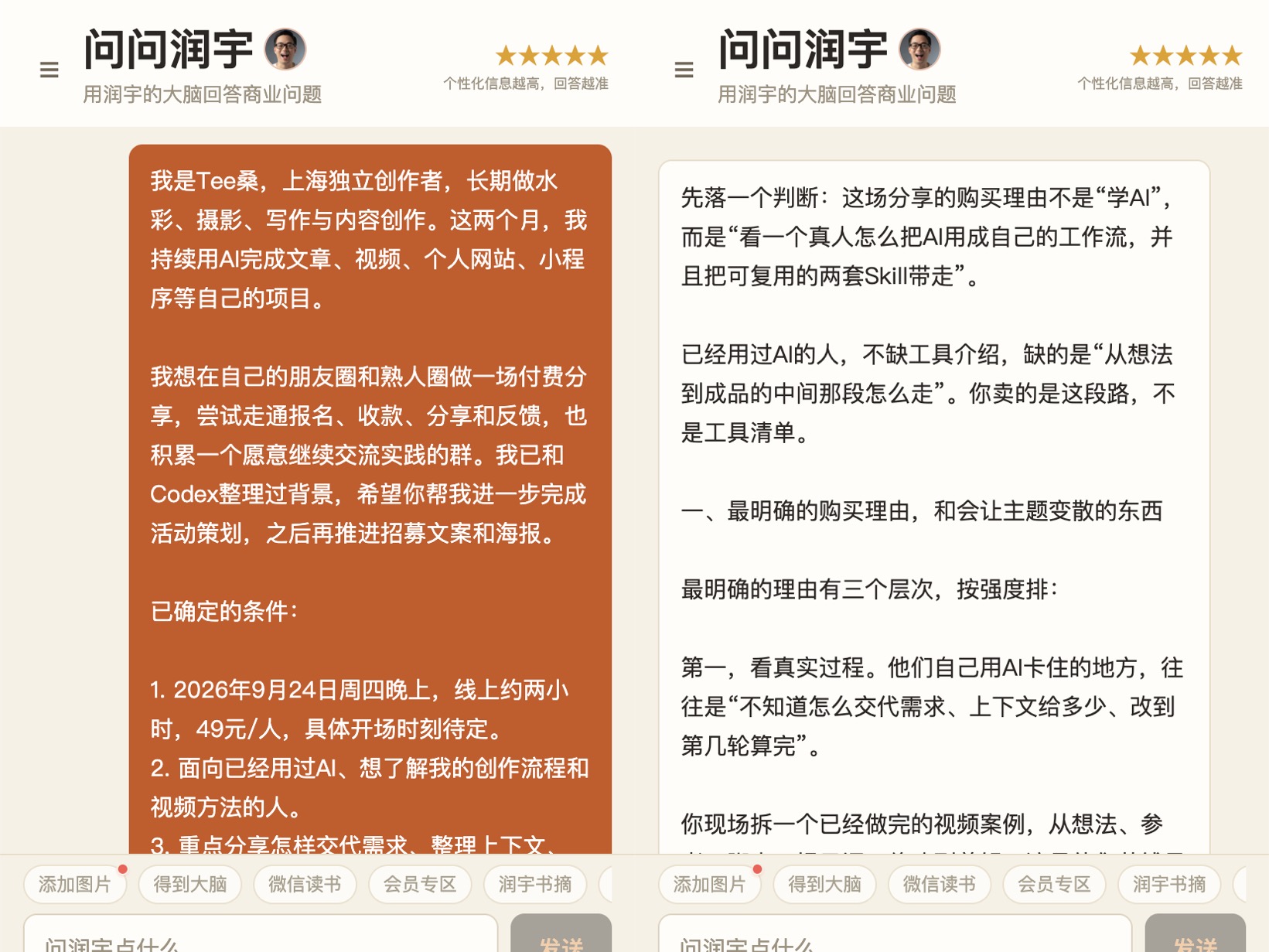
Open the original conversation image at full size
At first, we referred to an older poster for an in-person session. That session had focused on AI video. Adding the ready-made crystal jewelry example meant the conversation naturally continued down the video path.
That was also where the problem lay. We kept adding detail without coming back in time to check whether those details still served this particular session.
Once I realized we'd drifted, I explained the intended sequence again: first use Dedao Brain connected to local Obsidian to accumulate experiences, notes, and project materials; then, based on that context, use Codex to write articles, build a website, and make a mini program.
AI video belonged later, as one exploration within the process. I could discuss why I started, what happened when I tried following trending topics, and why I then turned toward commercial advertising demos. Video involves a considerable investment, and I didn't intend to encourage everyone to do it.
After I added that, Ask Runyu proposed a new theme and outline. The title “I Made AI into a System of My Own” emerged in this round. The knowledge base and actual projects returned to the front, with video as one example.
That adjustment was more useful than continuing to polish the video preview.
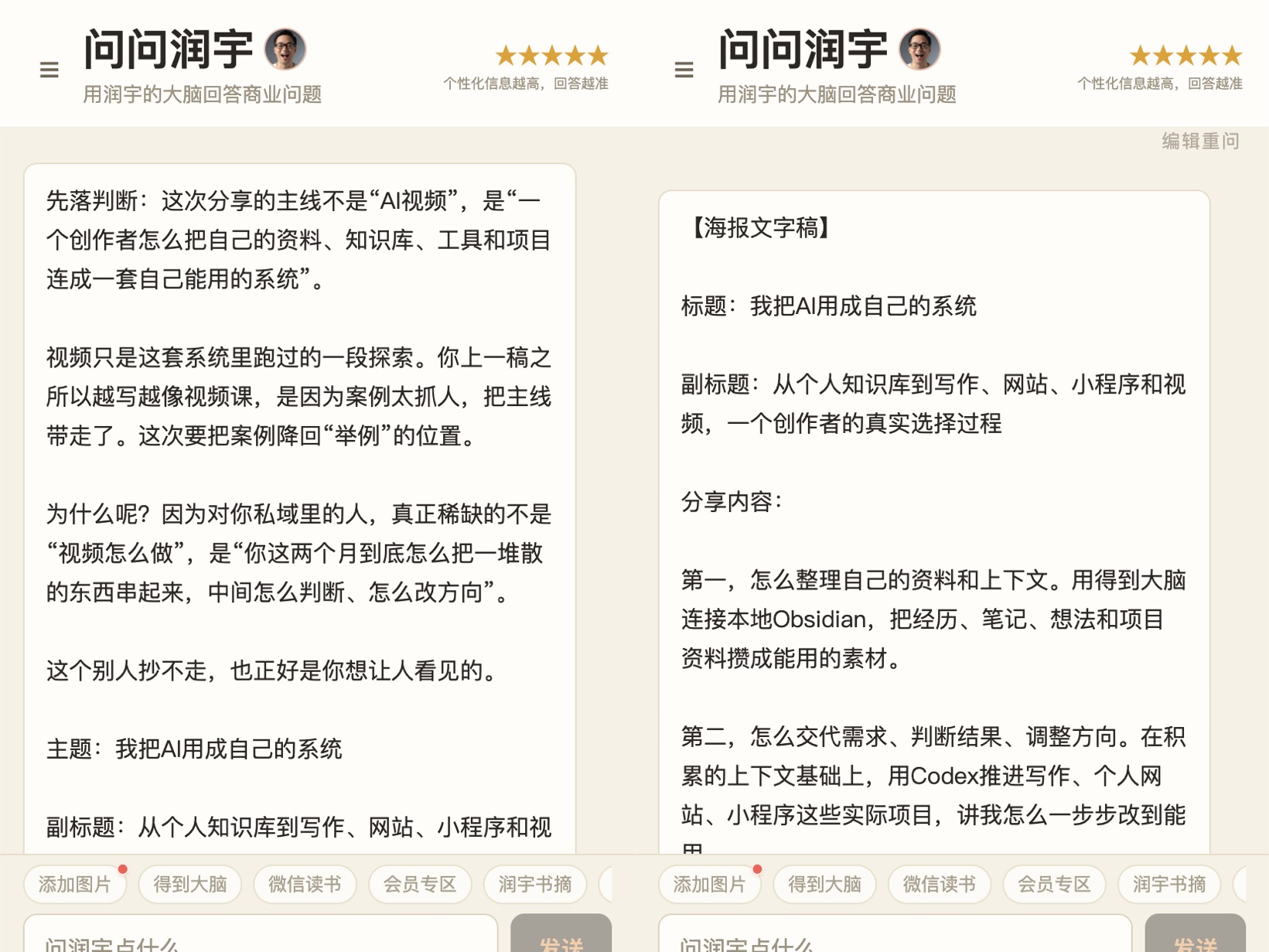
Open the original conversation image at full size
Deliverables and pricing also need to return to my purpose
There was another reminder from the early discussion that I kept.
I converted the old poster into text and asked what wasn't clear. It pointed out that the poster said “Make your own first AI short video,” while the session itself mainly involved watching the speaker demonstrate. Readers might expect to finish a piece of their own on the spot.
Yes, those really are two different expectations.
So this time, I clarified the deliverables: share the real process during the session, then provide a PDF, a writing collaboration Skill, and a video script and prompting Skill afterward. The two learner versions still needed testing. I'd explain their use according to paths that actually worked, without presenting “receiving materials” as “finishing a work during the session.”
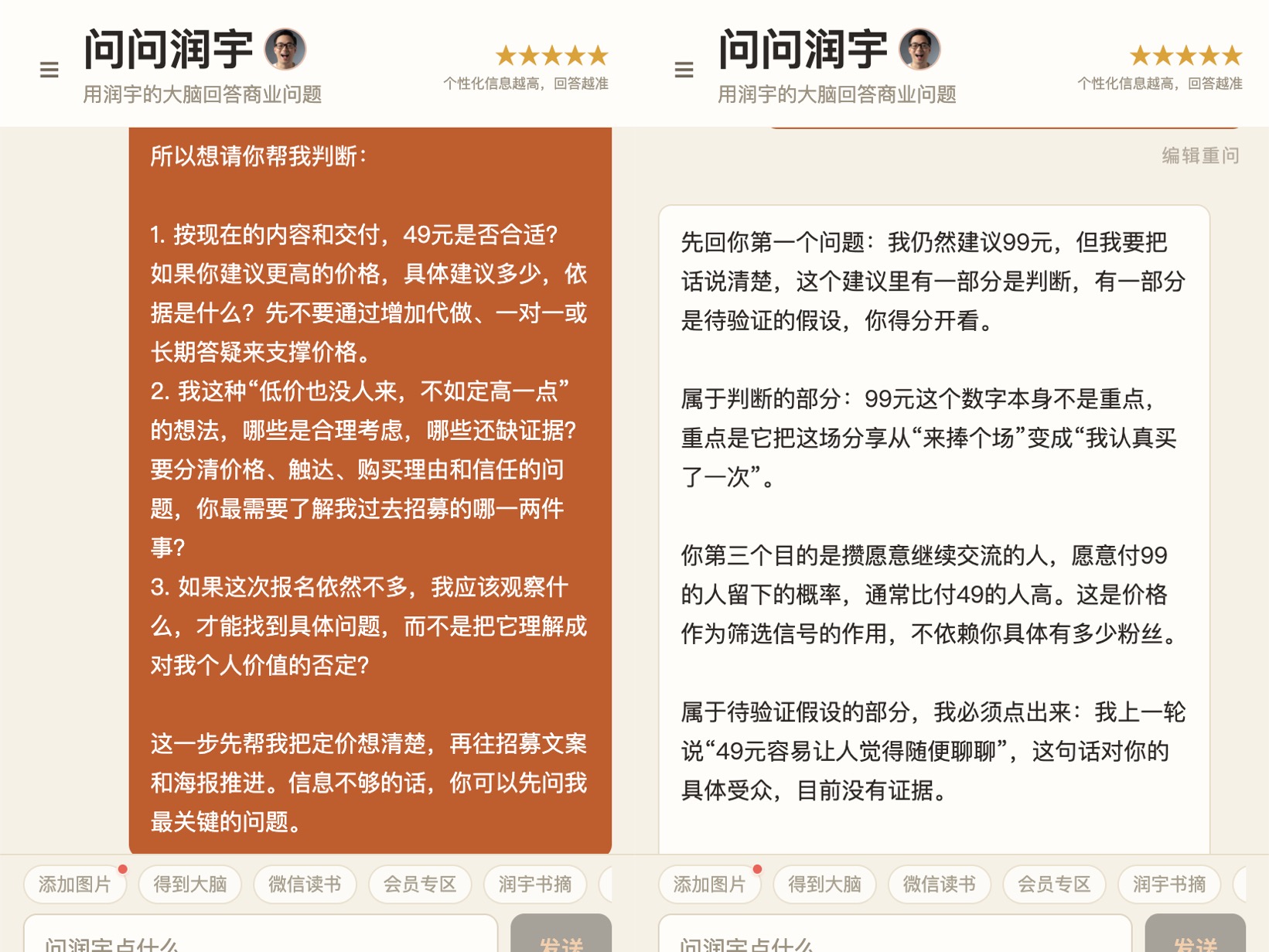
Open the original conversation image at full size
Pricing went back and forth too. I'd considered 49 yuan. Ask Runyu suggested 99 yuan, partly as a way to select more serious participants. But I wanted to pilot a paid session, give attendees something useful, and build some relationships through conversation. “Filtering people” wasn't my main purpose. Once I restored that premise, it accepted it and put 99 yuan back among the options.
Later, I still chose 99 yuan. But choosing that number in the end doesn't mean all the earlier reasons were valid. Whether the price suits my circle still depends on actual feedback.
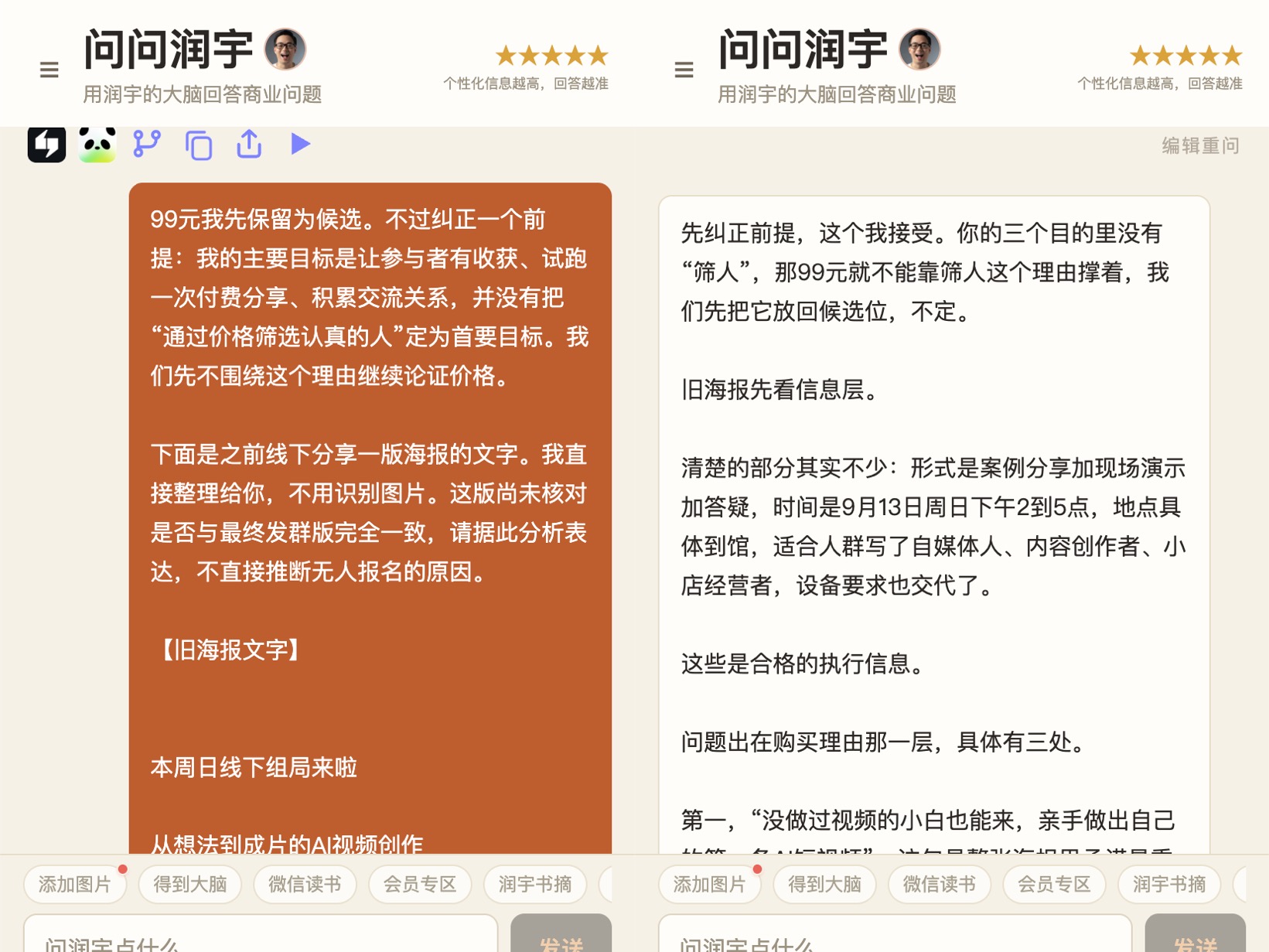
Open the original conversation image at full size
Does the poster look good, and does its information work?
As the plan became clearer, I moved on to the poster.
I chose the “Journal Expert” template and used the earlier watercolor scene of creating as the character reference. Art supplies, a computer, and books together also felt close to what I'm doing now.
The poster went through about three rounds of changes. At one point I asked Codex to help revise the prompt. It described the character's proportions, card positions, fonts, and space at the bottom in great detail, but the result didn't suit me any better. Later, I went back to the mini program's own prompt and tried again.
Some of the input needed correcting too. Promotional copy and style instructions had become mixed together; later I entered them separately. The promotional points Codex supplied also exceeded the 200-character limit and had to be shortened.
One version rendered “21:30” as “21:3.” I couldn't tell from the image alone whether the input had been truncated or generation had omitted a character. Afterward, I put the date and time clearly on separate lines and checked each item in the generated image.
These exchanges made me wish the tool separated event information, style requirements, and QR-code handling more clearly. If things like the time and price could be preserved exactly, that would remove one round of manual checking and rework.
The QR code especially deserves its own mention.
Some codes in the mini program's images looked plausible but wouldn't scan. There was also a case with one code inside the poster and another outside it. I had Codex generate a separate version too, and preferred its appearance, but its QR code wouldn't scan either. Regenerating and replacing it didn't solve the problem.
In the end, I pasted the original QR code onto the mini program's version in Affinity, then asked Codex to improve the text clarity. Both the version with the pasted code and the sharpened version subsequently passed local decoding checks, yielding the same content.
It's still unclear exactly which stage caused the problem. At least this time, I needed to add the original code manually. Seeing a QR code in an image wasn't enough to treat the registration entrance as finished.
I now plan to use the poster generated directly by Codex. Codex has enough context about my visual preferences, and I've also used it to make thousands of WeChat article covers and other article materials. Its generated visuals therefore suit my taste better.
The mini program's poster design feature is well suited to people without design knowledge, with thirty or forty templates to choose from. From feedback I saw in the members' group, the images can be suitable for delivery when high-quality output is selected.
The theme, outline, and event description that Ask Runyu helped develop have also remained part of this session. For me, its help happened at several stages: it raised questions, I supplied materials; I used some suggestions and kept explaining when others didn't fit my purpose.
The first poster drafts gave me something concrete to inspect and change. The final choice returned to my own taste and intended use. Since the inputs kept changing, this wasn't a rigorous comparison of tools either.
When the plan gets more detailed, come back and compare it with the original intention
Looking back, the action most worth keeping is to put what I originally intended to do beside the plan. As the plan grows more detailed, return to it and compare. Once it becomes a poster, check the time, price, and QR code separately too.
The session itself is still being prepared. The slides need to be made, the two Skills need testing, and actual registrations and feedback after the session will be recorded later. I want to note this part first, then return after I've actually delivered it to see which judgments stood up in real use.
The views, experiences, and final judgments in this article are the author's. AI assisted with organizing the text.
Return to the Ask Runyu series for more story films and learning notes
What did this bring to mind?
Share a memory, a different view, or a thought you would like to continue. No account is needed. Comments appear after review; readers’ words remain in their original language.
Conversation
Loading comments…