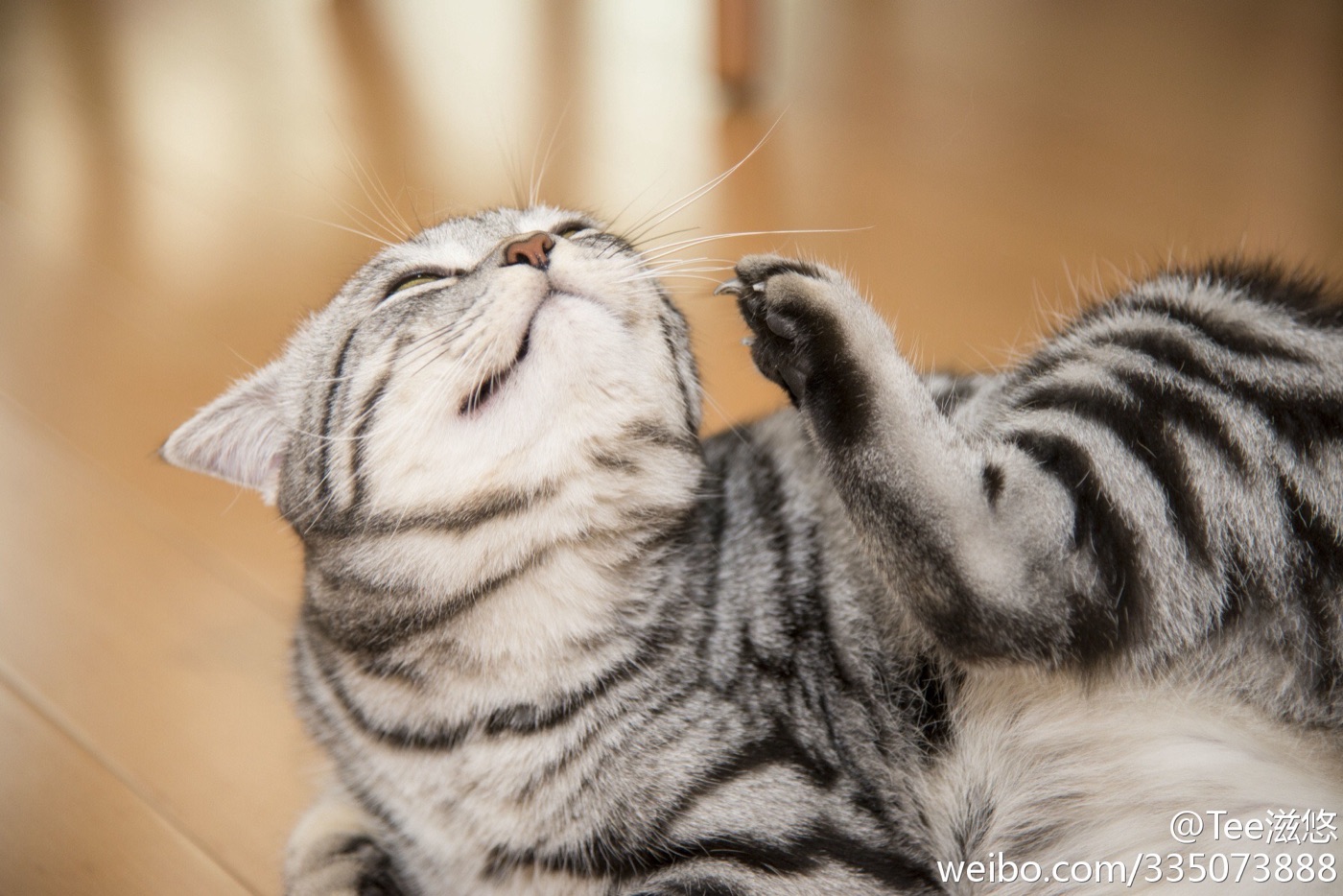
A cat who never crossed my boundaries made me mistakenly think I had none. Only when other relationships later hurt did I understand that what Sanmu gave me was not merely “an easy life,” but a rare sense of proportion: he came close without taking over, while I, over our long time together, gradually opened a door for him.
When I first got Sanmu, my painting table was small. Across its 1.2-meter surface, paints spread out on the left and watercolor paper lay on the right, leaving just enough room in the middle for my hand to move a brush.
That space was mine. I was sure of it.
But Sanmu seemed equally sure.
When he jumped onto the table, it was never an aimless leap. His front paws came up first, then his head turned left and right as though looking for a spot. Beside the palette would not do: too wet. Beside the paper would not do: too much in the way. Beside the rinse jar was even worse; it had splashed him once, and he remembered. So he walked halfway around and found an empty place about twenty centimeters from my right hand, outside any working area. He turned around twice and lay down.
The shape he made fitted exactly into the gap between everything on the table, without a space to spare.
The whole process took no more than ten seconds, as if rehearsed. It had not been.
I kept painting; he kept sleeping. Occasionally, as I changed brushes, my elbow touched the tip of his tail. He did not move away. The tail curled slightly, then curled back, and he kept sleeping.
That was our everyday life. I painted; he slept. One person and one cat shared a table, neither taking advantage of the other.
I did not yet know that what is truly rare is not companionship itself, but a living creature coming close while still leaving you room to move.
For those years, I thought I was a person without boundaries. Or rather, I thought my boundaries could expand indefinitely. As long as you did not go too far, I could accommodate you. Sanmu gave me that illusion because he never touched the line.
He did not push paint jars, step on the paper, or dip a paw into the rinse jar. Brushes lay at the edge of the table, and the palette was less than ten centimeters away. One stretch could create a disaster. But he did not. When walking around the palette, his paw pads seemed to have sensors: he never stepped anywhere wet. Passing the paper, he held his tail close, as though afraid of brushing against something.
Nobody taught him. I never told him “no.”
I thought this was my tolerance. Only later did I realize he had never given me anything that needed tolerating.
A person whose boundaries have never been touched does not know they exist.
So I only found out when another cat stepped across them.
Later, while away on a study trip, I kept another cat. Like Sanmu, it was an American Shorthair, but this one was a tabby-and-white “cheese cat,” with a pink nose and pink paw pads, very good-looking. I was living alone. I had loved the way Sanmu and I lived together in Shanghai so much that I assumed cats would all be much the same. Almost without thinking, I bought one to keep me company.
It turned out not every cat was Sanmu.
I was happy the day I brought it home. But things soon felt wrong.
It kept choosing the sofa, bed, or freshly washed clothes that had not yet been put away as its toilet. The litter tray was right beside it. I knew this might not be deliberate: it could be stress, physical discomfort, or anxiety about the new surroundings. But at the time, all I felt was the helplessness of being held back by everyday life.
It also chewed my brushes. Really chewed them, gnawing the bristles and leaving tooth marks all over the handles. Once I answered a phone call halfway through a painting. When I returned, the brush had been carried onto the floor, and its tip had split from the fall. I had used that brush for three years.
Its health was not very stable either. Every few days it would stop eating, have diarrhea, or develop inflamed eyes. I lived far from the city center, and each veterinary visit took half a day: a taxi into town, registration, examination, medication, several hundred yuan in all. I could afford the money, but that feeling of being held up again was irritating. I could have been painting, going out, or doing what I wanted. Instead, because it was ill again, I had to change my plans.
I had wanted a pet for companionship. With that cat, it felt as though life had suddenly dug another hole that I was required to jump into.
I did not dislike it. I simply had a vague feeling that something was wrong. Like wearing shoes a size too small: you can still walk, but every step presses somewhere. Not quite pain, just discomfort.
That was the first time I felt my boundaries. Not because the cat had done something unforgivable, but because I noticed myself keeping accounts in my head: how much money it had cost again, how much time it had taken again, how I could have painted three pictures today but had only painted one.
Once someone starts keeping that kind of account, the line has already been crossed.
Later, I also had a Shiba Inu, which collided with my boundaries differently. It did not destroy things. It needed me. Walks every day, company. While I painted, it rested its chin on my knee and looked up with bright eyes, its whole body saying, “Play with me.” I said, “Wait a minute.” It did not understand the words, but seemed to sense I was putting it off. Its tail slowed. Its eyes stayed on me, just a little less bright.
That look made me feel guilty. It was not that I did not like it. My way of life could not accommodate its needs.
But “not a good fit” was something I learned only through the collision. Something touched me and hurt, and I discovered the line was there. I did have boundaries.
Not an iron wall, but skin. You do not usually feel it, but when something touches it, you know where you end and the outside begins.
Sanmu had never made me feel that skin. Not because the boundary was weak, but because I did not even know I had it.
Later, I found a more suitable home for the Shiba Inu, with a yard, time, and people who sincerely liked it. I felt a little guilty on the day I took it there. But seeing it run around the yard, I also felt relief. From its point of view, it was not being abandoned by me. It was going somewhere its needs could finally be met.
After the pandemic, I returned to Shanghai and had my own studio. Sanmu was still staying with my parents then. Mom called to say something was wrong: he kept squatting in the litter tray and could not urinate. I rushed over and took him to hospital. A urinary blockage, a problem seen in male cats that can become dangerous if left too long. Sanmu was nine. It was the first time he had had a problem.
After colliding with boundaries, a person becomes more sensitive. That was why I truly panicked the year Sanmu developed the blockage.
He stayed in hospital for four or five days. I visited every day. He was in a small cage with a tube in his front leg. When he saw me, he called once, much more quietly than usual. I reached in to stroke him. He did not purr as he normally did. He just lay quietly, occasionally licking my finger.
It was the first time I realized Sanmu could be fragile too. He was usually so steady that I sometimes forgot anything could go wrong. He did not fuss, call out, or make trouble. You could almost think he needed no special attention. But seeing him curled up in that cage during the blockage made me suddenly feel that it was not that he did not need me. Usually, he kept his needs too well tucked away.
On the day he was discharged, I took him directly to my place instead of back to my parents’ home.
When Sanmu saw me, he was neither excited nor angry. He simply gave a little “mm,” then jumped into the carrier.
As though saying: oh, you’re back.
Only afterward did I slowly realize something: the boundary between Sanmu and me had never been fixed. It was changing.
In the early years, I thought our relationship was simply “I paint, he sleeps.” Two independent spaces, each living separately without disturbing the other. I thought that was the best arrangement. I needed nothing from him, and he needed nothing from me. A transparent wall stood between us. Neither touched it, but each knew the other was there.
Later, I discovered an opening in that wall.
I made it first.
I started leaving room for him. The things on my painting table had once been spread out casually. Later, I deliberately freed up more space on my right. Each time Sanmu jumped up, there was a little more room for him to lie down.
He seemed to notice too. He no longer only looked for gaps. Sometimes he would boldly take up half the table, his tail resting beside my paper. He would never have done that before.
Then came the keyboard. When I switched to a laptop, he would jump straight up and stretch his whole body across the keys. Gibberish began appearing on the screen: zaajskfgfjkahdklashkhdhjffg. I lifted him down; he jumped back up. I lifted him down again; he jumped back up again. The third time, I stopped lifting him.
He lay there with his body covering half the keyboard, so I had to connect an external one to type. Every now and then, Sanmu rubbed against the keys under his belly, and an extra letter or two appeared on the screen. I felt no particular emotion about it. I simply deleted them. I stroked him a couple of times, he purred, and his eyes narrowed as though he had won.
Was I annoyed? Yes.
At the same time, I thought: he is finally making trouble for me.
Usually, when I painted and he did not get in my way, I occasionally wondered whether he cared about me. When he lay on the keyboard, I felt sure he could tell when to disturb me and when not to. His chosen method landed exactly at “annoying, but not enough to make me angry.”
He tested the opening. I chose not to close it.
Then there was licking my fingers. I do not know when Sanmu began liking the water on my fingers. Once, after washing my hands without drying them, I reached over to stroke him and he instinctively licked them. Later it became a habit. Whenever I held out a finger, he came over to lick it. At first, I dipped it in water and he licked diligently. Later, I did not need the water. Whichever finger I offered, he licked.
That little barbed tongue felt rough and ticklish on my finger. It seemed less like looking for water and more like checking that I was still there.
But when friends held out a finger, he rarely licked it. The same finger, the same gesture. He sniffed, then turned away.
Recognizing the person. Recognizing the smell.
The little “mm” at the door was the same.
When I went out, Sanmu barely reacted. He did not follow me to the door, call, or rub against my legs. It was as though my going out had nothing to do with him.
But every time I returned, the moment the key entered the lock, I heard a “thump” inside: Sanmu jumping down. By the time I opened the door, he was already sitting near the entrance, looking up at me and making one brief “mm.”
Plain and quiet, without excitement or complaint. Just “mm.”
But that “thump” gave him away. He had been lying comfortably until he heard the key. He had come over especially.
Two creatures who disliked trouble had each stayed inside their own space, thinking it safest not to touch. But as time passed, they discovered a door could be opened in the wall. Leave it open, and air can enter, and so can someone else. I let him in a little further, and he let me in a little further too.
No need to confirm it. No need to explain.
The key sounds, and he jumps down.
I open the door, and he says “mm.”
The wall is still there.
But we have already opened a door in it for each other.
Wood
Sanmu’s Memoir
A 14-year-old cat, a painter who has not held a regular job for 14 years, and 14 years under the same roof
What did this bring to mind?
Share a memory, a different view, or a thought you would like to continue. No account is needed. Comments appear after review; readers’ words remain in their original language.
Conversation
Loading comments…