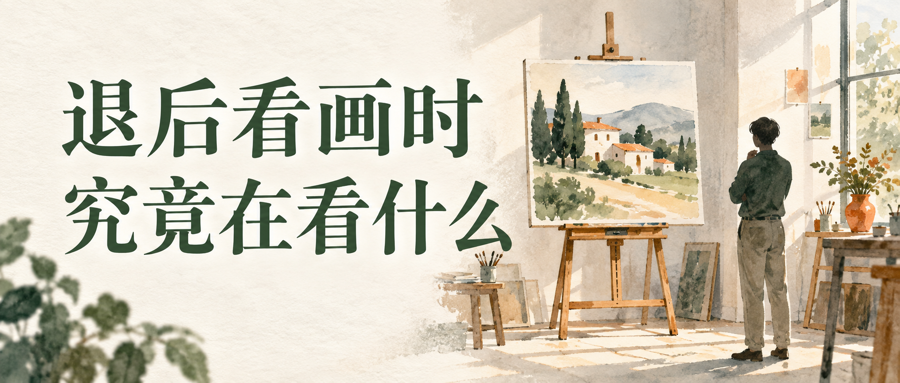
Have you ever had this happen while painting watercolor: you're increasingly pleased with one small area, while the painting as a whole feels less and less coherent?
When painting, we often say: step back and look at your work.
The action is a little like squinting at the picture. As we paint, it's easy to fixate on one area: the shape here isn't quite right, the color there could be adjusted a little more. Step back or narrow your eyes, and small details become less noticeable. It's easier to see the larger relationships across the painting.
There is a condition, though. You need some idea of what those “larger relationships” are and what you're looking for. Otherwise, standing up and taking a few steps away may only leave you feeling that something is odd, without knowing why.
Composition, the relationships among black, white, and gray, the overall color scheme, and where you want viewers to look first: these are all things you can examine again from a distance.
I think it's especially worth noticing whether anything has stolen attention from the focus you originally wanted.
You meant the painting to center on this spot, but as you worked, you put a great deal of effort into an area beside it. That part became more detailed, its color stronger, and its edges clearer. On its own, it may be quite well painted. Put it back into the whole picture, and it divides the attention.
This doesn't happen only to beginners. Someone like me, who often bends over a desk and becomes absorbed in painting, can also overdo one place. It may not seem problematic at the time because my attention has stayed there, and I even think I've improved it.
So sometimes I need to put the picture farther away and see what the things I've just added are actually doing in the whole painting.
Generally, when we want a painting to have a clear focus, we need to establish priorities. Add a little where we want people to look and subtract a little elsewhere. Then viewers can more easily notice what we're trying to express.
Adding doesn't have to mean adding details. Sometimes it's a clearer contrast of light and dark, a touch of color, or a definite stretch of edge. Elsewhere, we can then hold back. We don't have to explain everything equally fully.
Especially with painting on location and quick sketches, we often want to paint something because it interests us or moves us. But there is so much in front of us. Leaves, windows, gaps between bricks, reflections on water: we can't reproduce them all in a short time.
Painting from photographs is the same. A photograph contains so much information that putting it on paper inevitably involves choices.
If we're going to subtract, we need to think about what is worth keeping and what can be passed over. The way we arrange details is connected to why we wanted to paint this scene in the first place.
For example, suppose I'm painting a landscape and want to emphasize a nearby house or tree. I'll usually give those places more detail and clearer contrast. Distant buildings may be simplified so they recede.
In some scenes with a strong sense of atmosphere, distant colors become cooler and grayer, with weaker contrast. These changes help create depth. Of course, not every landscape has to be warm in the foreground and cool in the distance. It still depends on the light in front of us and what we actually feel.
But if I get too involved in the distant buildings, describe every window and eave clearly, and use saturated colors and strong contrasts, they may jump forward. I may end up confusing the depth I originally wanted to establish.
At that point, stepping back and squinting often make it easier to notice: why is that the first place I see? Is it too prominent? Could there be fewer details beside it?
After noticing this, I don't necessarily need to add more to the subject. Sometimes softening the attention-grabbing area makes the whole painting feel right.
“When we first look at a painting, there usually isn't time to study every detail. What we feel first is whether the whole picture holds together.”
Where the handling is clever, or which brushstroke is interesting, comes later, when we move closer and look slowly.
So for me, stepping back means drawing myself away from the area I've been staring at and looking at the painting as a whole again. That small area may already be rich with detail, but does it still fit beside everything else?
“This is also what I'd like to practice together in the in-person watercolor workshop.”
On location, with so much in front of us, what should we choose to paint first and what can we leave out? Halfway through, what has taken over the focus, and should we strengthen something or hold back next? Discussing these judgments on the actual sheet you're painting makes them far more concrete.
If you're in Shanghai and would like to go out painting together, you can contact me privately to arrange an outing. Briefly tell me what you've painted, what you want to paint, or what you're most unsure about now, and we can discuss a suitable arrangement.
The views, experiences, and final judgments in this article are the author's. AI assisted with organizing the text.
What did this bring to mind?
Share a memory, a different view, or a thought you would like to continue. No account is needed. Comments appear after review; readers’ words remain in their original language.
Conversation
Loading comments…