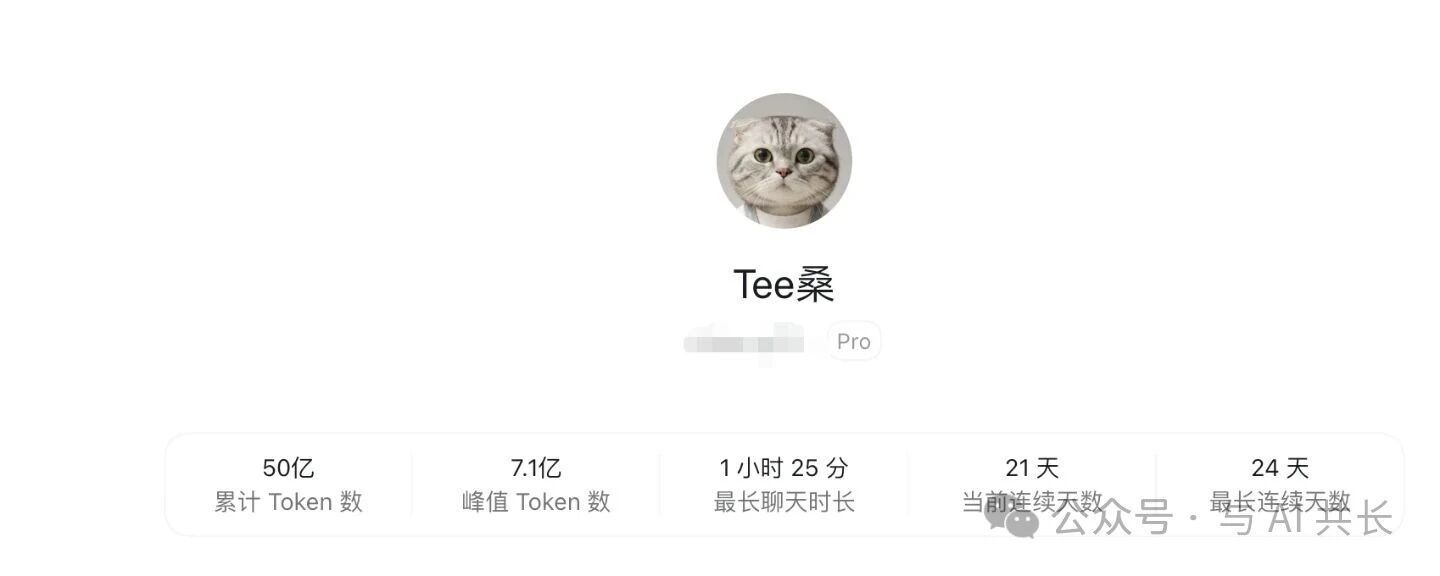
Today, my cumulative Codex usage reached five billion tokens.
My quota dashboard told me that. It records the changes every hour, and I'm particularly sensitive to the quota going up and down. A few days ago, I saw the number jump and thought I'd misread it. Looking further, I found it had actually reset four times in six days.
I was a little annoyed.
After the quota resets, I no longer invent projects for myself
I'd already worked out roughly how much I could use each day. When the quota reset, it felt as though I'd missed out on using a chunk of it. But if I actually had to find a big project on the spot to consume it, I couldn't think of anything suitable. I even briefly wondered whether I should make a game. Then I thought again: that wasn't a real need of mine. Creating a task just because I still had quota wasn't the right rhythm either.
So I let myself have the feelings, and carried on with the work as usual.
Going from 200 million to one billion took me 26 days. From one billion to three billion took 12 days. From three billion to five billion took only six. Recently, I've been collaborating with Codex for seven or eight hours almost every day. The numbers have been rising faster, and the things I've made have begun to take concrete shape.
The mini program and my personal website are both officially live. I've also done quite a lot of research, organized materials, and sorted through work and relationships accumulated over the years. Things that used to be vague notions in my head can now quickly become versions I can open, test, and keep revising.
But the change within those latest two billion tokens that I most want to record is actually the research.
Needs no longer walk up to me on their own
My old way of creating content was straightforward. Put something out, let people see it and ask about it, then offer a service based on what they needed. In the earlier years of using Sina Weibo, the platform still had organic reach, and I posted a lot. As long as content kept appearing, there were usually plenty of opportunities to be seen. Needs came to me.
After a few years away from social media, I returned to find that this sequence no longer worked so well.
I still need to make content, but now I also have to work out how to get it in front of the right people. Even good wine can go unnoticed down a deep alley. In the past, I was better at making things. Now I also have to learn how to call attention to them, step into the crowd, and see what people are actually asking.
Putting watercolor learners' questions into the judgment library
One thing I've been asking Codex to do more often recently is collect the problems people encounter while learning watercolor. How do you choose supplies? Why is water so hard to control? What do you do when colors get muddy? How do you preserve a finished painting? Previously, research like this meant opening posts one by one, copying the questions, and slowly arranging them in a spreadsheet. Now I can let AI make a broad first pass at collecting and grouping them, then go back and judge which questions are genuine, which repeat one another, and which are worth answering.
This research is making its way into the WeChat mini program I'm building, Ask Tee Sang.
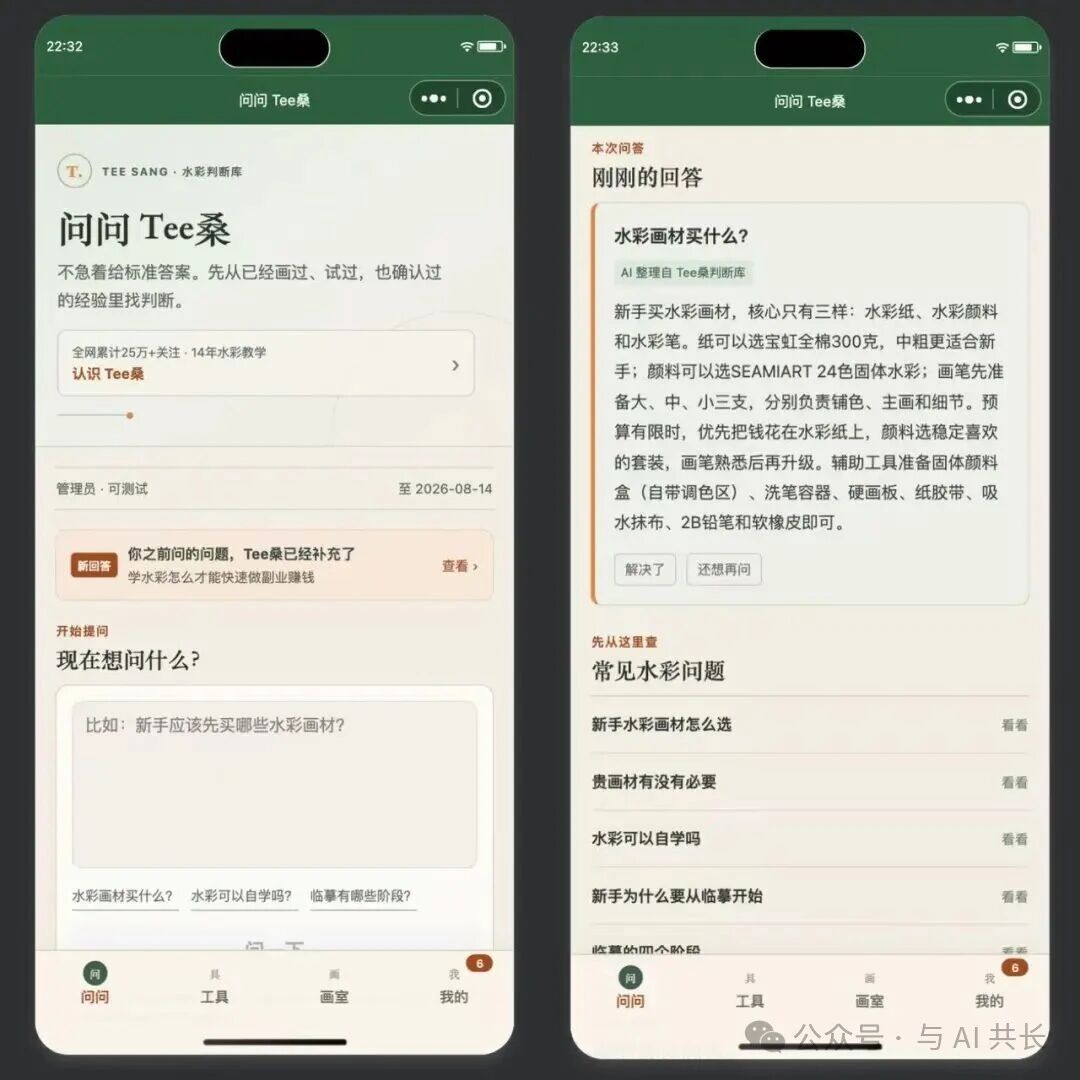
I'm an independent creator living and working in Shanghai, and I've been making and teaching watercolor for more than a decade. In the past, that experience was scattered across classes, paintings, and individual answers to questions. I first began making Ask Tee Sang because I noticed how many basic, small questions tend to come up at the beginning of an inquiry. People phrase them differently, but the uncertainty may be much the same. Answering them again and again took a fair amount of time.
Ask Tee Sang is a WeChat mini program for watercolor learners. It organizes answers based on painting judgments I've confirmed. When a question falls outside the judgment library, it keeps the question for me to add to later.
As of August 27, the judgment library exported from the cloud contained 61 published judgments. Each had to have an answer I had confirmed. AI understands the different ways people ask, then organizes an answer from those judgments. If it can't find enough support, it explicitly tells the user that the question isn't yet covered by the library.
This matters to me.
"I'm not trying to make a painting chatbot that can say a few things about absolutely anything. I'd rather it were a book of questions and answers that keeps growing."

AI can help organize what's inside, but the judgments behind the answers come from me. Which supplies are worth buying, what to practice first as a beginner, whether there's a more reliable way to handle a problem: all of these need to be traceable to my own experience and choices.
Look for questions first, then come back to make content
As I worked on this, I began to rethink how an independent creator can use AI to find real needs. The research adds content to the judgment library, and it also adjusts the way I look at the market.
I used to tend to start with what I could do. I can paint and write, and now AI also helps me build websites and mini programs. So I made those things first, then waited for people to come closer. There's nothing wrong with that approach; it was just missing a step. I also need to go and see what the people I want to serve are struggling with, what they would pause to look at, and what would make them willing to keep talking.
A few days ago, I listened to a livestream by Liu Run. He spoke about the need to keep adapting to a changing environment. At the time, I felt I had that ability. Thinking about it now, ability alone isn't enough. It has to show up in specific things I do each day.
For me, those actions are fairly modest for now. Look at more real questions, do a little more work organizing data, and put the recurring needs into the product. Keep publishing content too, but don't just stand still and wait after publishing it.
Five billion is just a number. The change is in the order of the work.
Five billion is, of course, only a number. It shows that I've used the tool a lot lately; it doesn't prove I've done anything right. What's actually useful is that this use has begun to change the sequence of my work. Before, I expressed something first, then waited for needs to appear. Now I go looking for questions, come back with them to make content, and keep improving the mini program in my hands.
As for when the quota will reset again, I still can't predict it. If the dashboard jumps, I'll probably still feel a little sting. Then I'll close the page and get on with what I had originally planned to do that day.
For now, I don't intend to make that game just to use up quota. I still have 61 judgments to keep checking, and plenty of real questions waiting for me to notice them.
The views, experiences, and final judgments in this article are the author's. AI assisted with organizing the text and generating illustrations.
What did this bring to mind?
Share a memory, a different view, or a thought you would like to continue. No account is needed. Comments appear after review; readers’ words remain in their original language.
Conversation
Loading comments…