This comic continues the Moon Lamp story. Once you have found the people to speak with, what should you ask next? In Runyu and Sisi’s interview, five successive questions are a practice exercise, with each new question responding to the answer before it. I turned this into a conversation in a teahouse, moving from “wanting to relax before bed” to “how you relax now,” then asking how it feels after scrolling on a phone. As the questions become more specific, the original idea of selling a lamp begins to encounter doubts.
The Follow-up Teahouse: Where Do the Questions Get Stuck?
Runyu × Sisi | From User Insight to Product Development · Scene 03. Ask more deeply, while allowing the answers to overturn your own idea. The user answers on this page are hypothetical examples. The original lettering is in Chinese; the English dialogue appears beneath each panel.
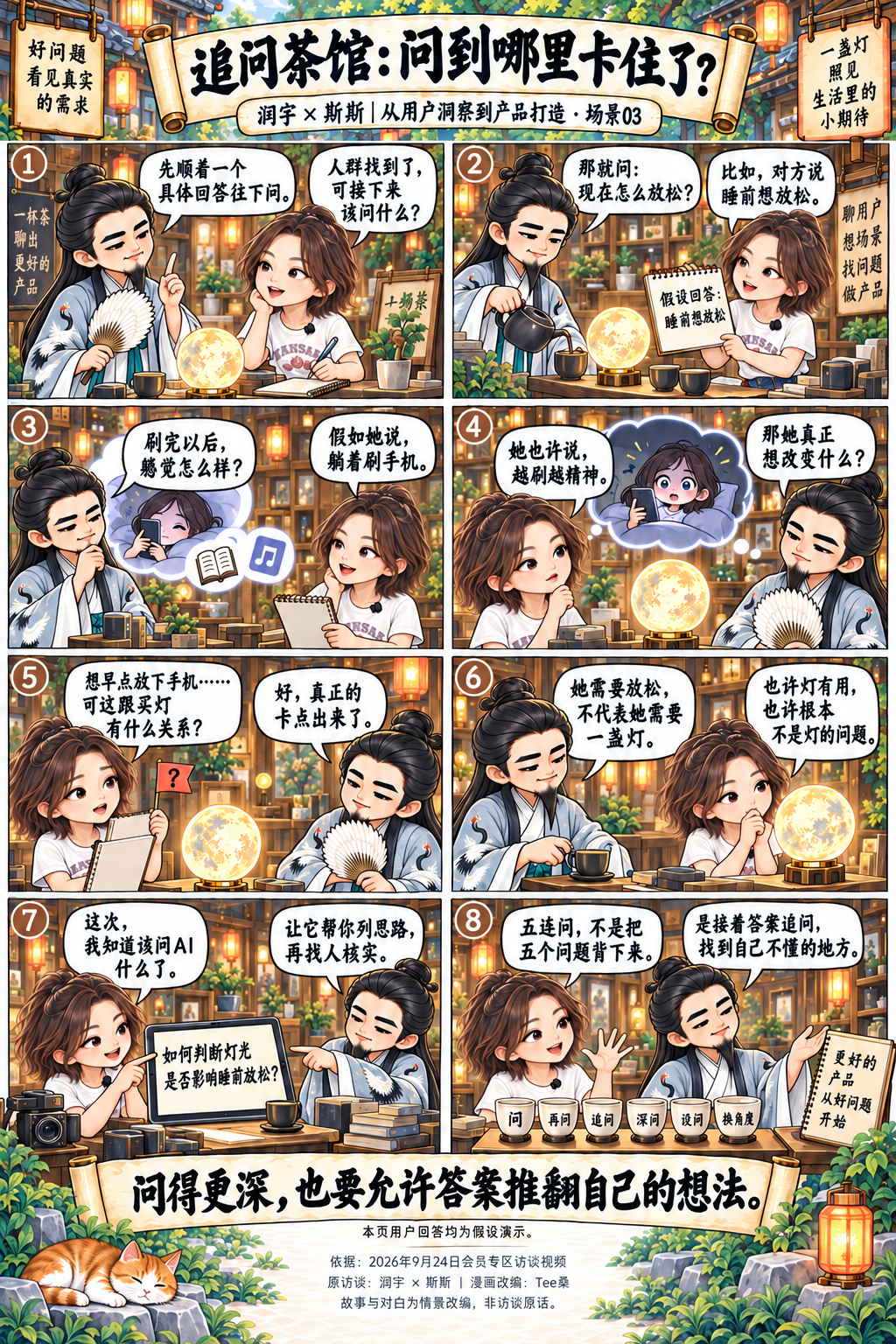
Sisi: We’ve found the group, but what should we ask next?
Runyu: Follow one specific answer and keep asking.
Begin by following one specific answer. Signs: “Good questions reveal real needs”; “A pot of tea, a conversation toward better products”.
Sisi: For example, she says she wants to relax before bed.
Runyu: Then ask: how do you relax now?
If she wants to relax before bed, ask how she relaxes now. Notebook: “Hypothetical answer: I want to relax before bed.” Sign: “Talk to users, picture situations, find problems, make products.”
Sisi: Suppose she says she lies in bed scrolling on her phone.
Runyu: How do you feel after scrolling?
If she says she lies down and scrolls on her phone, ask how she feels afterward.
Sisi: She might say the more she scrolls, the more awake she feels.
Runyu: Then what does she actually want to change?
If she becomes more awake the longer she scrolls, ask what she really wants to change.
Sisi: She wants to put her phone down earlier... but what does that have to do with buying a lamp?
Runyu: Good. Now we’ve found where we’re really stuck.
Wanting to put the phone down earlier: what does that have to do with buying a lamp?
Runyu: Needing to relax does not mean she needs a lamp.
Sisi: Maybe a lamp would help. Maybe the problem has nothing to do with a lamp at all.
Needing to relax does not yet establish a need for a lamp.
Sisi: Now I know what to ask AI.
Runyu: Let it help you outline some approaches, then check them with people.
Ask AI to outline possible approaches, then check with people. Laptop: “How can we tell whether lighting affects relaxation before bed?”
Sisi: Five successive questions doesn’t mean memorizing five questions.
Runyu: It means following the answers with questions, until you find what you don’t understand.
The exercise is to follow the answers and find what you do not understand. Cup labels: “Ask,” “Ask again,” “Follow up,” “Go deeper,” “Pose a question,” “Change perspective.” Notebook: “Better products start with good questions.”
Ask more deeply, while allowing the answers to overturn your own idea.
One lamp illuminates the small hopes in everyday life.
The user answers on this page are hypothetical examples. Based on the members-only interview video of September 24, 2026. Original interview: Runyu × Sisi. Comic adaptation: Tee Sang. The story and dialogue are fictionalized, not verbatim interview quotations.
Looking back at this adaptation, the most useful pause is “What does this have to do with buying a lamp?” If what she wants to change is endlessly scrolling before bed, how exactly could a lamp help? There is no answer yet. Further questions might reveal that the product needs adjusting, or that the matter has nothing to do with a lamp. In the comic, Sisi takes the uncertainty to AI to outline possible approaches, then returns to real people to check them. I have kept that sequence. AI can help think of questions, but hypothetical answers ultimately have to be checked with real people.
The learning source is Runyu and Sisi’s interview in the first business lesson in the paid community Runyu’s Entrepreneurship Notes, organized from my learning record dated September 24, 2026. Tee Sang and AI made the comic together. The Moon Lamp case, scenes, and character dialogue are a fictionalized adaptation, not a verbatim transcript of the interview.
Continue reading The User Portrait Studio · The Business Three-Way Junction · The Ask Runyu Series
What did this bring to mind?
Share a memory, a different view, or a thought you would like to continue. No account is needed. Comments appear after review; readers’ words remain in their original language.
Conversation
Loading comments…