Who could you sell a beautiful lamp to? In the comic, Sisi first says “people who like beautiful things,” then thinks of people who have just moved into a new home. Only after more questions do a young person renting alone away from home and the time before bed after work come into view. In turning this learning into a comic, I used a moon lamp to connect the questions. We may still be talking about something “beautiful,” but put it in a particular room and life, and its brightness, size, placement, and the amount someone is willing to spend all become things we need to understand further.
The User Portrait Studio: Who Exactly Are We Selling To?
Runyu × Sisi | From User Insight to Product Development · Scene 02. Turn “anyone could buy it” into a specific group, situation, and problem. The Moon Lamp case and dialogue are a fictionalized adaptation; the user needs still need testing. The original lettering is in Chinese; the English dialogue appears beneath each panel.
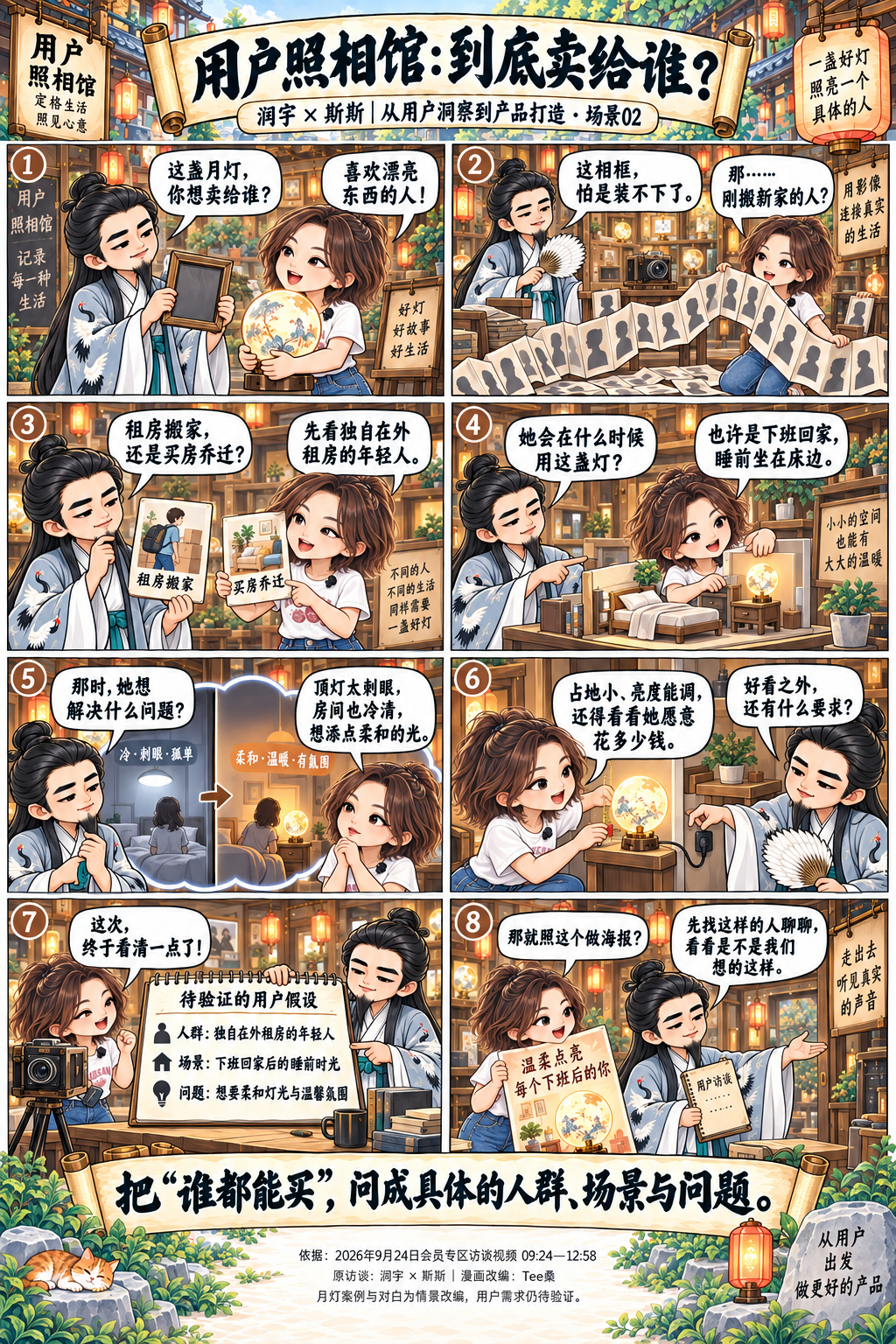
Runyu: Who do you want to sell this Moon Lamp to?
Sisi: People who like beautiful things!
Start with “people who like beautiful things.” Signs: “User Portrait Studio: frame life, reflect what is in the heart”; “User portraits: record every kind of life”; “A good lamp, a good story, a good life.”
Runyu: I’m afraid that frame won’t fit them all.
Sisi: Then... people who have just moved into a new home?
People who have just moved are still a very broad group. Sign: “Connect with real life through images.”
Runyu: Moving into a rental, or into a home they’ve bought?
Sisi: Let’s start with young people living alone in rented homes.
Distinguish moving between rentals from moving into a purchased home. Photo labels: “Moving between rentals” and “Moving into a purchased home.” Sign: “Different people, different lives, all need a good lamp.”
Runyu: When would she use this lamp?
Sisi: Perhaps after coming home from work, sitting by the bed before sleep.
Keep asking until a specific situation appears: home after work, sitting beside the bed before sleep. Sign: “Even a small space can hold plenty of warmth.”
Runyu: What problem does she want to solve at that moment?
Sisi: The ceiling light is too harsh, and the room feels cold and empty. She wants to add some soft light.
Is the problem a glaring ceiling light, or a room without soft lighting? Inset labels contrast “Cold · Harsh · Lonely” with “Soft · Warm · Atmosphere.”
Runyu: Apart from looking nice, what else does it need to do?
Sisi: Take up little space, have adjustable brightness, and fit what she is willing to spend.
Size, brightness control, and budget still need to be clarified.
Sisi: This time, we can finally see a little more clearly!
Write the group, situation, and problem as a user hypothesis to test. Board: “User hypothesis to test. Group: young people renting alone. Situation: time before bed after coming home from work. Problem: wanting soft lighting and a warm atmosphere.”
Sisi: Shall we make the poster based on this, then?
Runyu: First find people like this to talk to, and see whether things are as we imagine.
Talk to real users before deciding on the product or poster. Poster: “Warmly light up every you coming home from work.” Notebook: “User interviews.” Sign: “Go out and listen to real voices.”
Turn “anyone could buy it” into a specific group, situation, and problem.
One good lamp lights up the life of one specific person.
Start with users to make better products.
Based on the members-only interview video of September 24, 2026, 09:24–12:58. Original interview: Runyu × Sisi. Comic adaptation: Tee Sang. The Moon Lamp case and dialogue are fictionalized; the user needs remain to be tested.
Looking back over these eight panels, I also want to retain the last step. A clear user profile on paper still needs to be followed by conversations with people like that. She may like the lamp, or she may simply want to put her phone down earlier, or she may not want to add anything else to a small room at all. The need for a moon lamp in the comic is a hypothesis. However specifically I draw it, there must still be room for real answers to change it.
The learning source is the first business lesson interview between Runyu and Sisi in the paid Runyu’s Entrepreneurship Notes community, organized from learning notes dated September 24, 2026. Tee Sang made the comic in collaboration with AI. The moon-lamp example, story situations, and character dialogue are dramatized adaptations, not a verbatim transcript of the interview.
Keep reading: The Follow-up Question Teahouse · The Business Three-Way Junction · The Ask Runyu series
What did this bring to mind?
Share a memory, a different view, or a thought you would like to continue. No account is needed. Comments appear after review; readers’ words remain in their original language.
Conversation
Loading comments…