Marketing, sales, and growth all sound as though they have something to do with selling things. When making this comic, I continued thinking with the moon lamp from the earlier story. First, help someone understand the value of soft light before bed. Then explain the models, prices, and ways to buy. The situation has already moved from understanding value to a specific transaction. Putting the same object through these scenes makes it a little easier to distinguish what each of the three words is doing.
The Business Three-Way Junction: How Do the Three Signs Differ?
Runyu × Sisi | From User Insight to Product Development · Scene 05. Marketing explains value, sales helps people buy, and growth looks for new opportunities. These are plain-language interpretations for this interview, not complete definitions. The original lettering is in Chinese; the English dialogue appears beneath each panel.
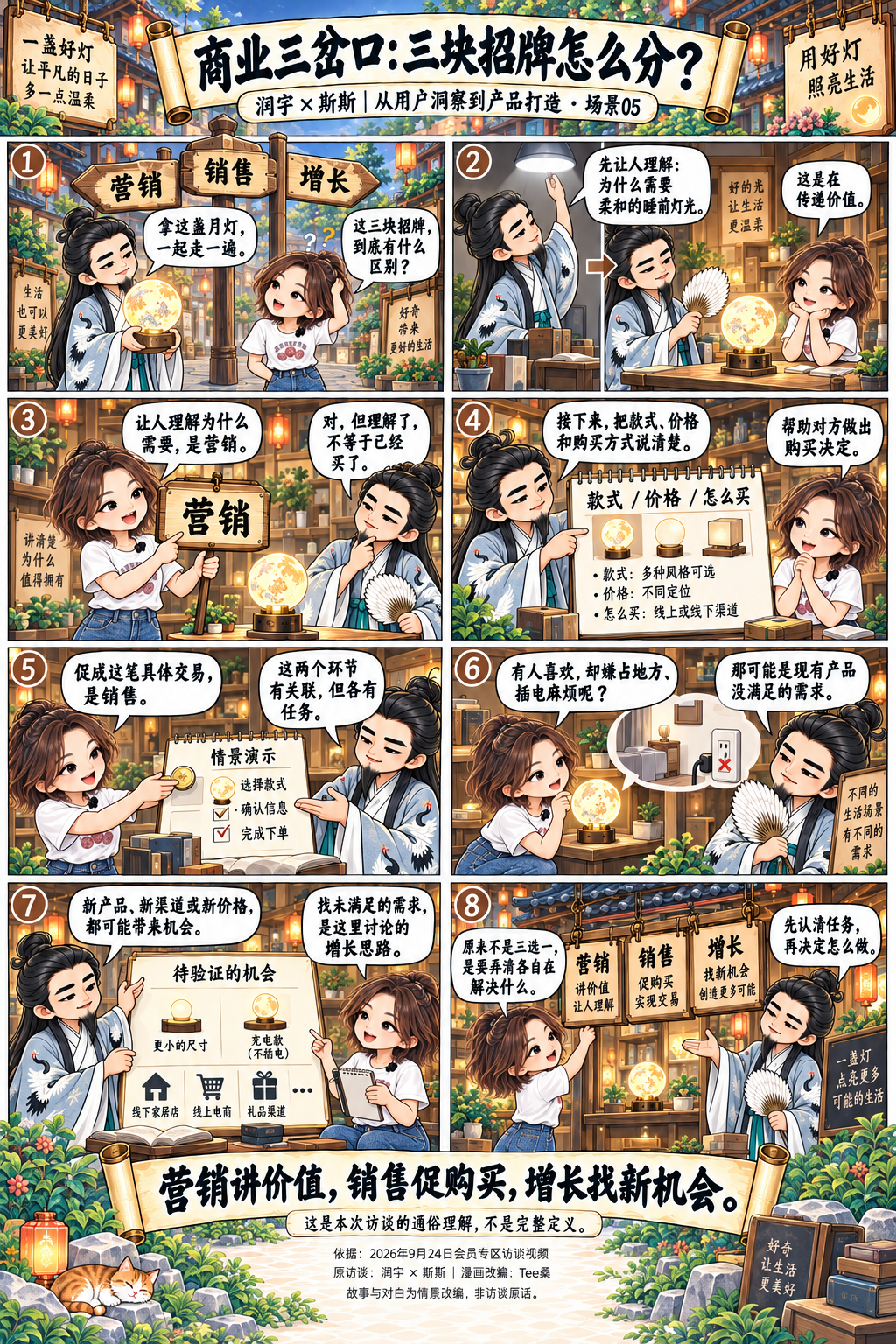
Sisi: What exactly is the difference between these three signs?
Runyu: Let’s take this Moon Lamp down each path.
Use the same lamp to examine marketing, sales, and growth. Three signposts: “Marketing,” “Sales,” and “Growth.” Side signs: “Life can be more beautiful” and “Good things bring a better life.”
Runyu: First help people understand why they might need soft lighting before bed.
Sisi: That is communicating value.
Explain what soft lighting before sleep is for, helping people understand its value. Sign: “Good light makes life gentler.”
Sisi: Helping people understand why they need it is marketing.
Runyu: Yes, but understanding it doesn’t mean they have already bought it.
Understanding the value is not the same as having bought it. Sign: “Explain why it is worth having.” Sisi holds a “Marketing” sign.
Runyu: Next, explain the styles, prices, and how to buy clearly.
Sisi: Help the other person make a purchasing decision.
Explain styles, prices, and how to buy, so people can make a purchasing decision. Board: “Style / Price / How to buy. Style: a choice of designs. Price: different price points. How to buy: online or offline channels.”
Sisi: Helping this particular purchase happen is sales.
Runyu: The two stages are connected, but each has its own job.
Help a specific transaction happen. Demonstration board: “Choose a style. Confirm the details. Complete the order.”
Sisi: What if someone likes it but thinks it takes up space or is a nuisance to plug in?
Runyu: That could be a need the current product does not meet.
Notice needs an existing product has not met, such as taking up too much room or the inconvenience of plugging it in. Sign: “Different living situations have different needs.”
Runyu: New products, new channels, or new prices could all create opportunities.
Sisi: Finding unmet needs is the approach to growth we’re discussing here.
New products, channels, and prices are opportunities to test. Board: “Opportunities to test. Smaller size. Rechargeable version, without a power cord. Physical homeware shops. Online stores. Gift channels. ...”
Sisi: So it isn’t a choice of one out of three. We need to understand what each one solves.
Runyu: First identify the job clearly, then decide how to do it.
Distinguish explaining value, helping a purchase, and finding opportunities. Signs: “Marketing: explain value, help people understand”; “Sales: help purchases, complete transactions”; “Growth: find opportunities, create more possibilities.” Side sign: “One lamp lights up more possibilities in life.”
Marketing explains value, sales helps people buy, and growth looks for new opportunities.
A good lamp adds a little warmth to ordinary days.
Use a good lamp to light up life.
Good things make life more beautiful.
These are plain-language interpretations for this interview, not complete definitions. Based on the members-only interview video of September 24, 2026. Original interview: Runyu × Sisi. Comic adaptation: Tee Sang. The story and dialogue are fictionalized, not verbatim interview quotations.
At the sign marked "Growth," new questions appear in the comic. Someone thinks the lamp takes up too much room; someone else finds plugging it in inconvenient. These lead to ideas for smaller sizes, rechargeable versions, and other sales channels. They are all still opportunities to test. Whether changing the design or the place where it is sold will lead to purchases depends on further attention to actual needs. In this illustrated exercise, I use these scenes to help me understand the interview. I do not treat eight comic panels as complete definitions of three business concepts.
The learning source is the first business lesson interview between Runyu and Sisi in the paid community Runyu's Entrepreneurship Notes, organized from my learning notes of September 24, 2026. The comic was made by Tee Sang in collaboration with AI. The moon-lamp example, story settings, and character dialogue are dramatized adaptations, rather than a word-for-word transcript of the interview.
Continue with The Customer Portrait Studio · The Follow-up Teahouse · The Ask Runyu series
What did this bring to mind?
Share a memory, a different view, or a thought you would like to continue. No account is needed. Comments appear after review; readers’ words remain in their original language.
Conversation
Loading comments…