I have never been to Kazan.
I came to know the city through a few photographs forwarded by one of my students. She is an English teacher and is learning watercolor with me. A friend of hers in Kazan, Russia, had taken some autumn photographs, and she passed them on to me.
I found the autumn colors beautiful, so I made two paintings. Later, she showed them to her friend, who liked them very much and hoped I would paint more.
That made me curious about the names of the buildings in the photographs, when they had been built, and the stories people in that city had grown up reading.
I painted, looked things up, and read.
01 I wanted to linger by the white tower
Golden treetops nestled against white walls. Street lamps lined the path, and two people sat on a bench. Some leaves still clung to the branches; others had fallen around their feet.
The photograph showed a building, but it also held a place where you could sit down and rest.
This is the Preobrazhenskaya Tower, one of the gate towers of the Kazan Kremlin. Its history reaches back to the sixteenth century.
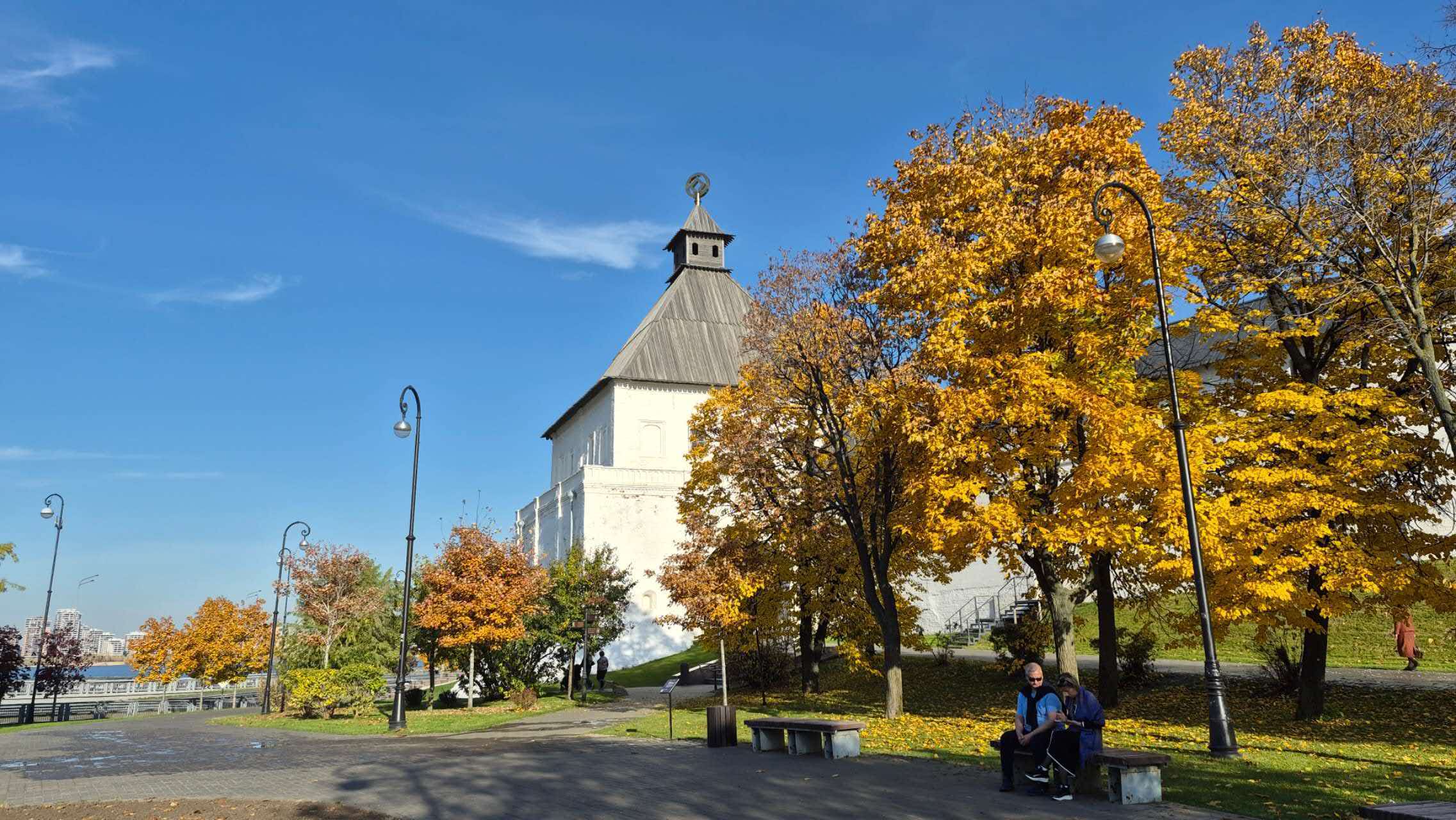
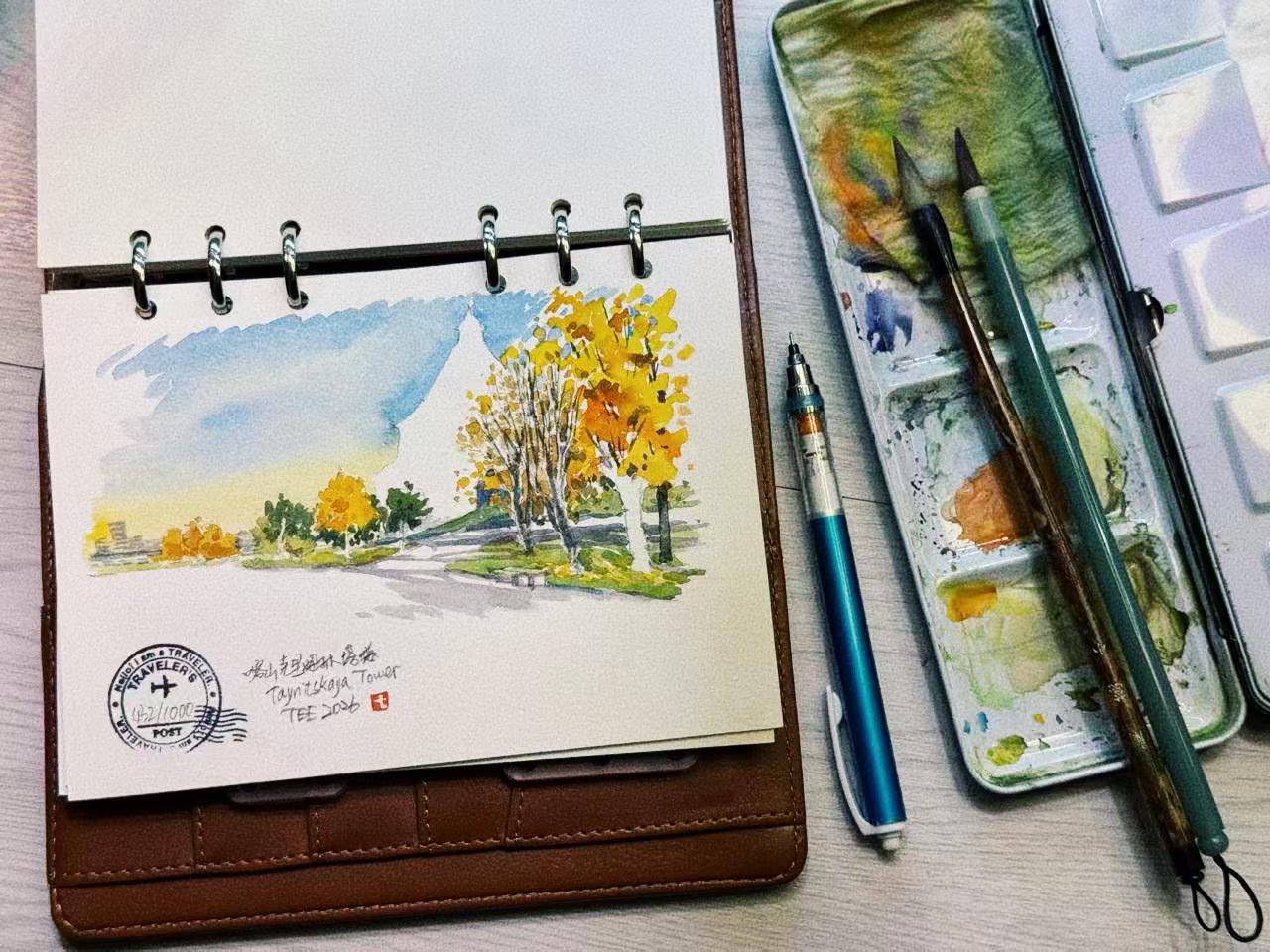
When I painted it, I placed the tower a little to the right and left room for a bare tree on the left. Its branches were fine and took time to paint, but they gave weight to that side of the composition. Without them, the tower would have stood there all alone.
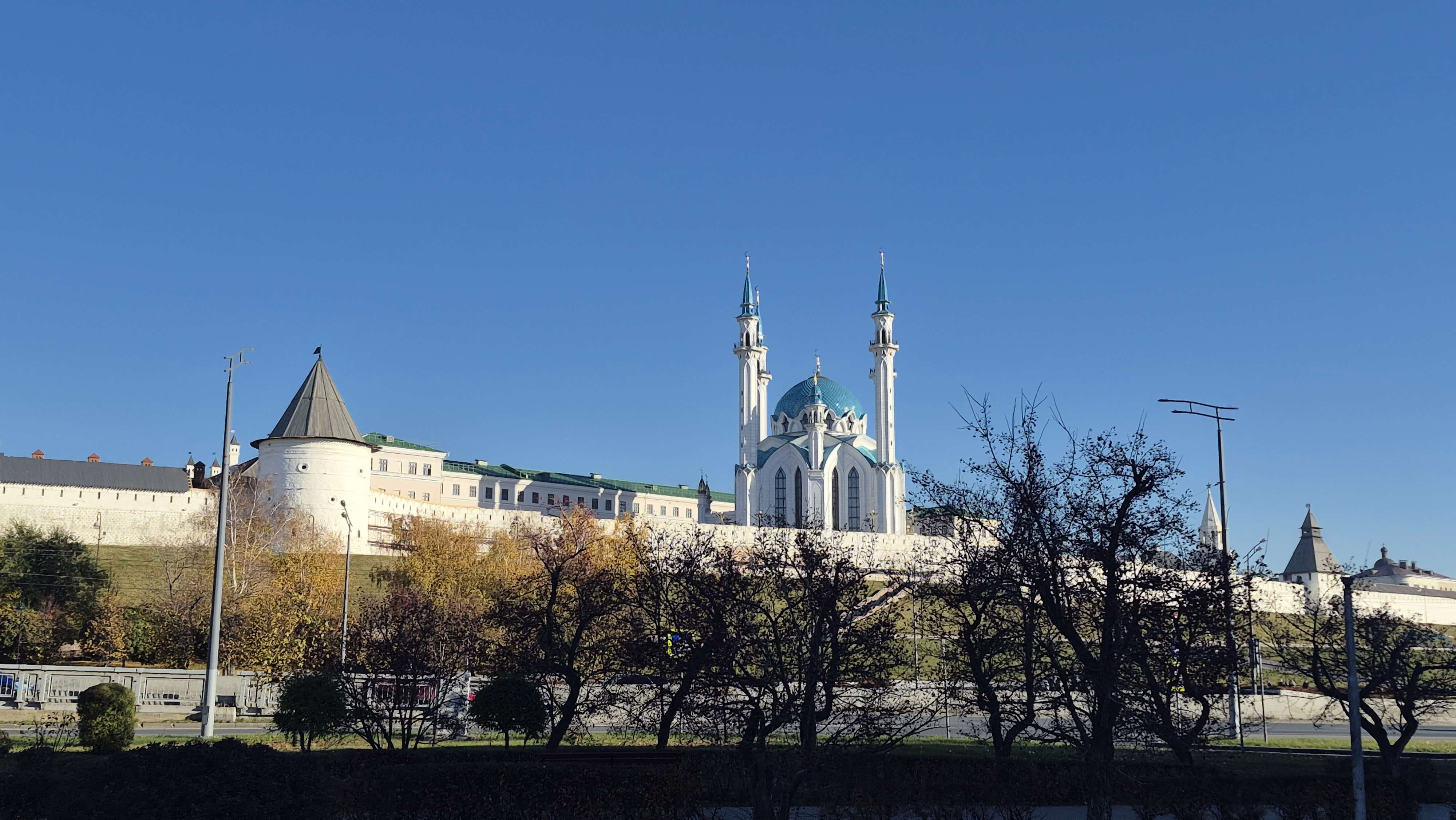
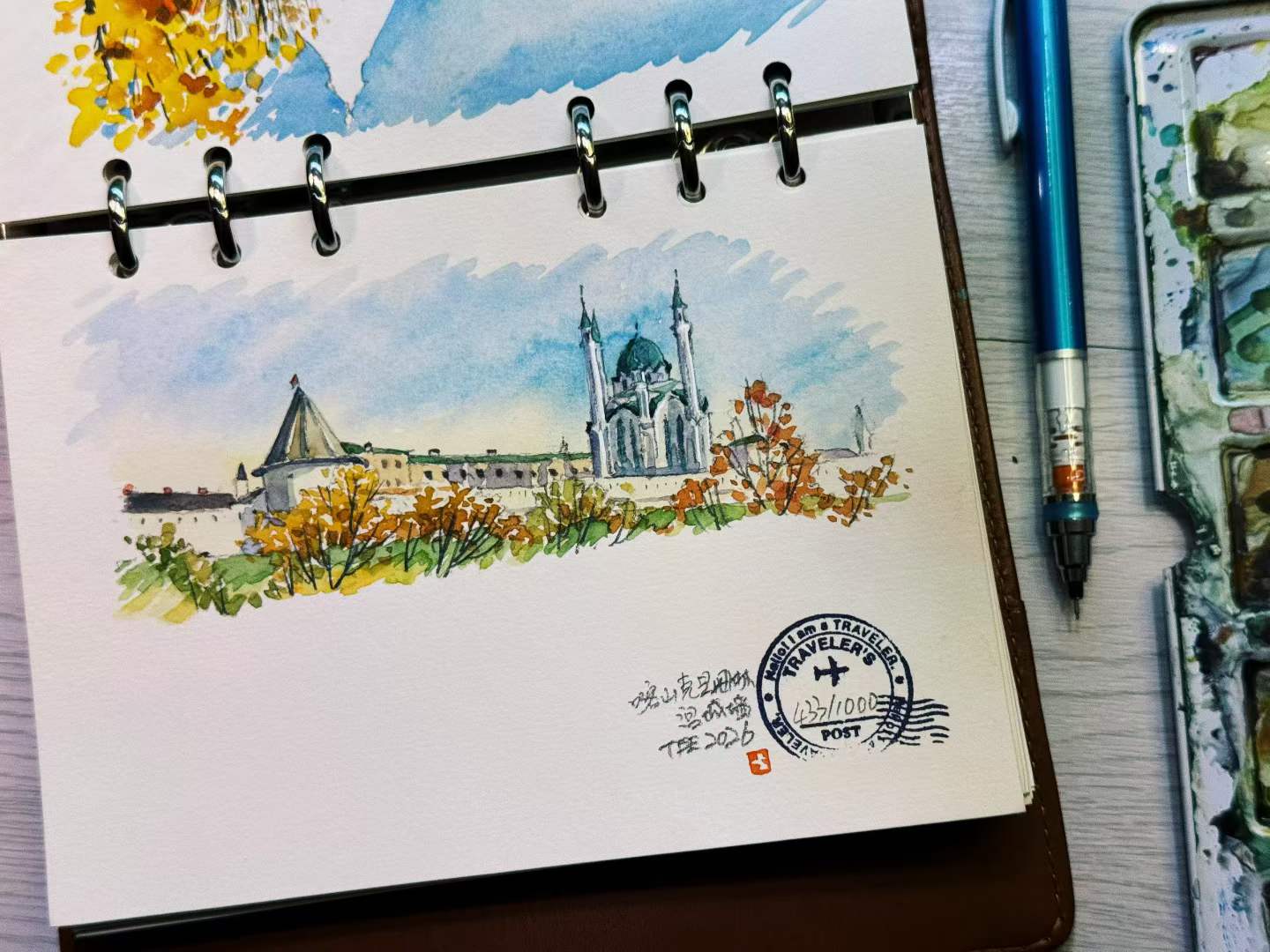
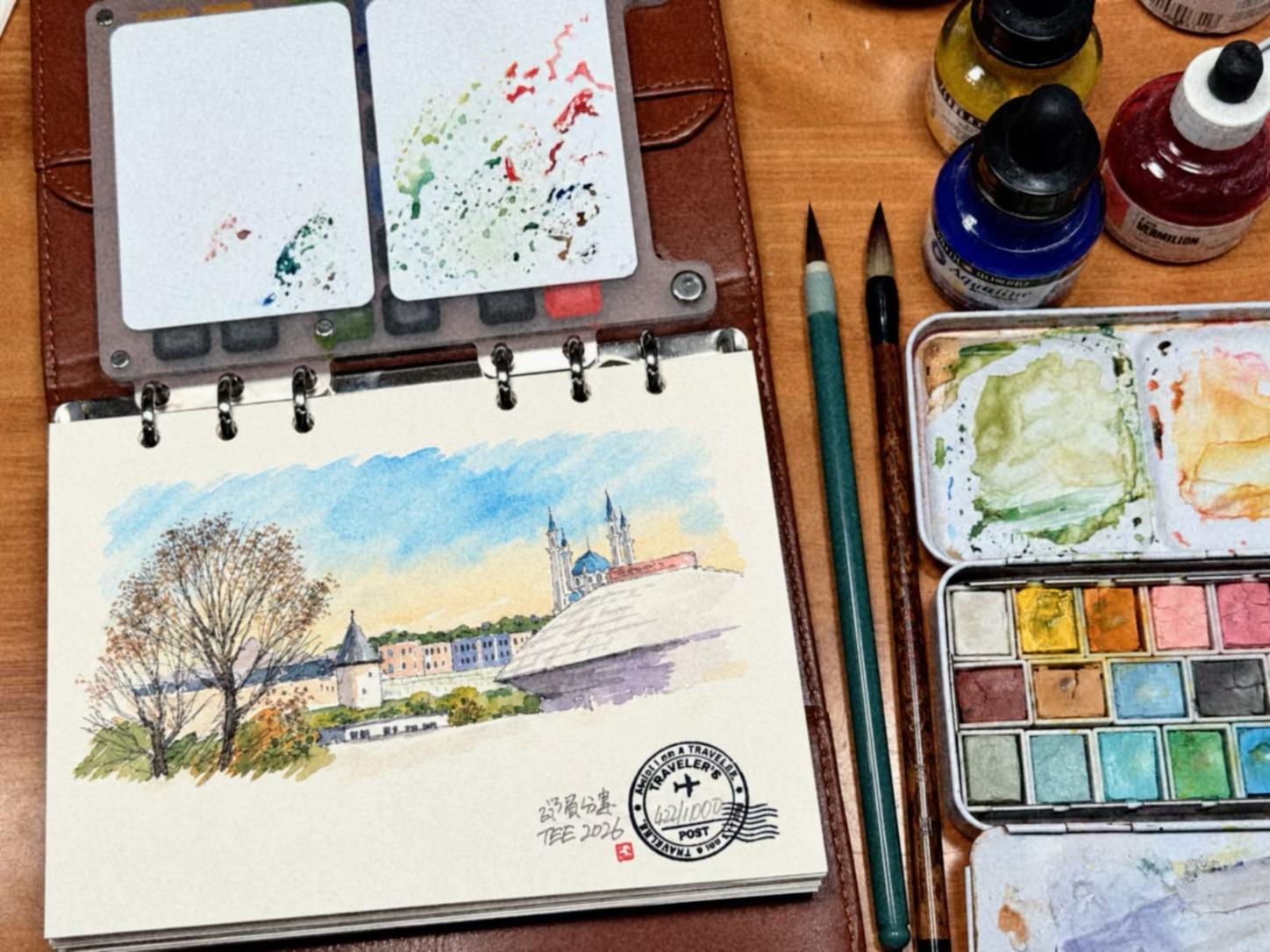
In another photograph, turquoise domes rose above the white walls.
The minarets were slender, with four spires around a large central dome. The blues in the picture were quite different: the sky was bright, while the dome was deeper and more subdued, like the same cloth seen in sunlight and in shade.
This is the Kul Sharif Mosque. Only when I looked it up did I learn that it was built between 1996 and 2005.
I had assumed that a mosque standing inside an old fortress must also be several hundred years old. Yet the tower dates to the sixteenth century, while the mosque was completed in the early twenty-first. They stood so close together in the photographs, with more than four centuries between them.
Nothing in the photographs had told me that.
Looking back at my two paintings, I still liked the colors: white walls, blue domes, yellow leaves. But knowing this, I no longer saw the wall as just a backdrop.
A photograph shows things as they are at that moment.
It has no obligation to tell you that two things in the frame belong to different ages.
02 I painted a saucer-shaped building
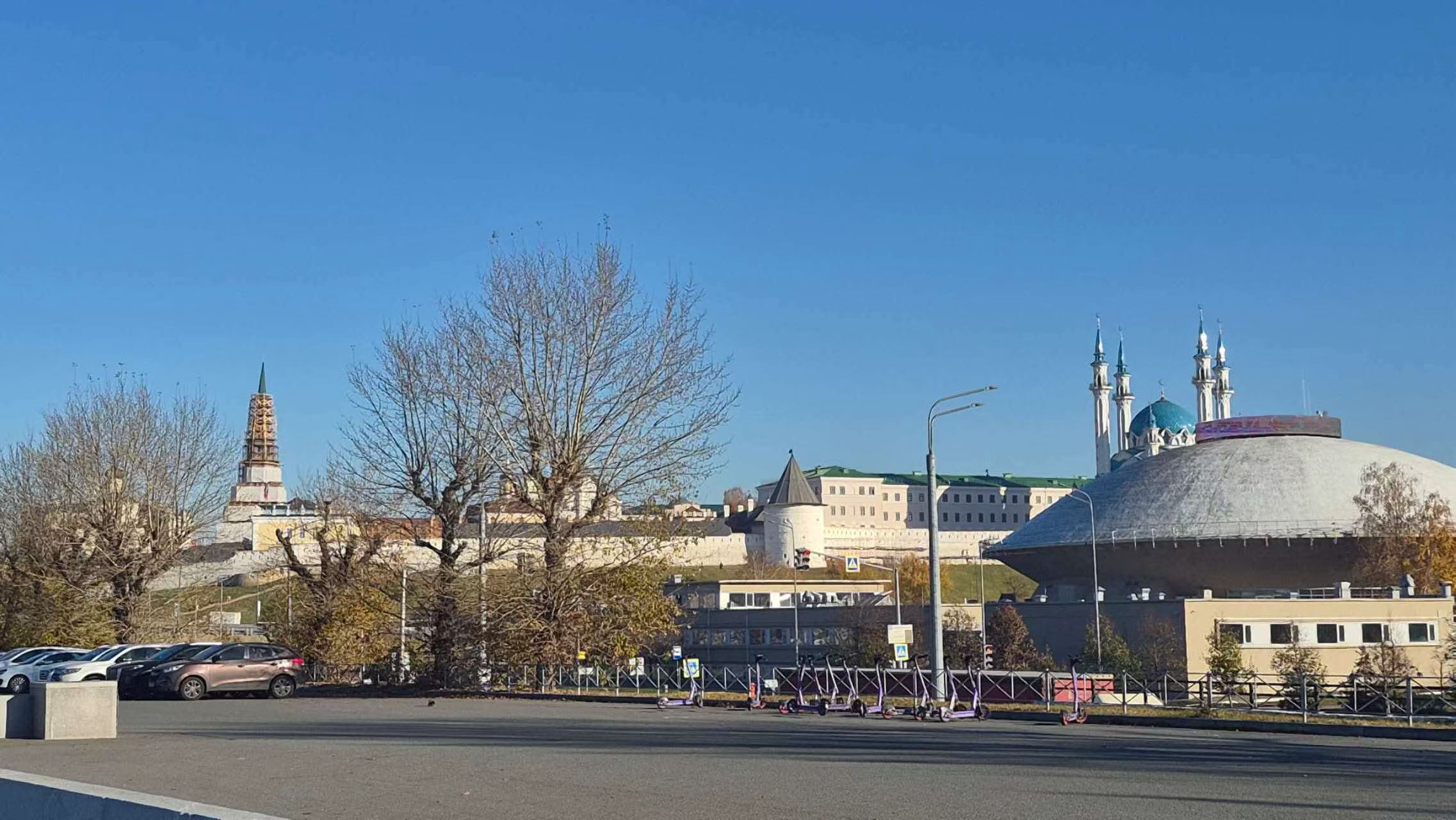
In the third photograph, a saucer-shaped building appeared in front of the city walls.
Its center dipped inward, and the rim turned up slightly all the way around. I am hardly the first to compare it to a flying saucer; almost everyone seems to think of one at first sight. This is the Kazan State Circus. It opened in 1967, almost forty years before the mosque was completed.
The composition of this photograph was rather cluttered.
The saucer filled the upper half. Below it lay a flat expanse of pavement marked with parking spaces, with a few cars parked there. A row of scooters, some orange and some green, stood secured along the roadside. A lamp post in the left foreground ran almost the full height of the frame.
Judged as a scenic photograph, all of these might count as distractions. The cars should be moved, the scooters should not be there, and that lamp post was decidedly in the way.
I painted the composition as it was and kept those things in. Removing them would have been easy. The picture would have been much tidier, but also emptier. A city's character often lies in these seemingly unimportant details: someone parks here, someone arrives on a scooter, a lamp post stands where it stands, and nobody bothers to move it just to improve the view.
By this point, my interest in the city had shifted from “Where are the beautiful views?” to “How do people spend their ordinary days here?” So when I came to a photograph of a path whose name I did not know, I was thinking about something else.
03 I wanted to know where that path led
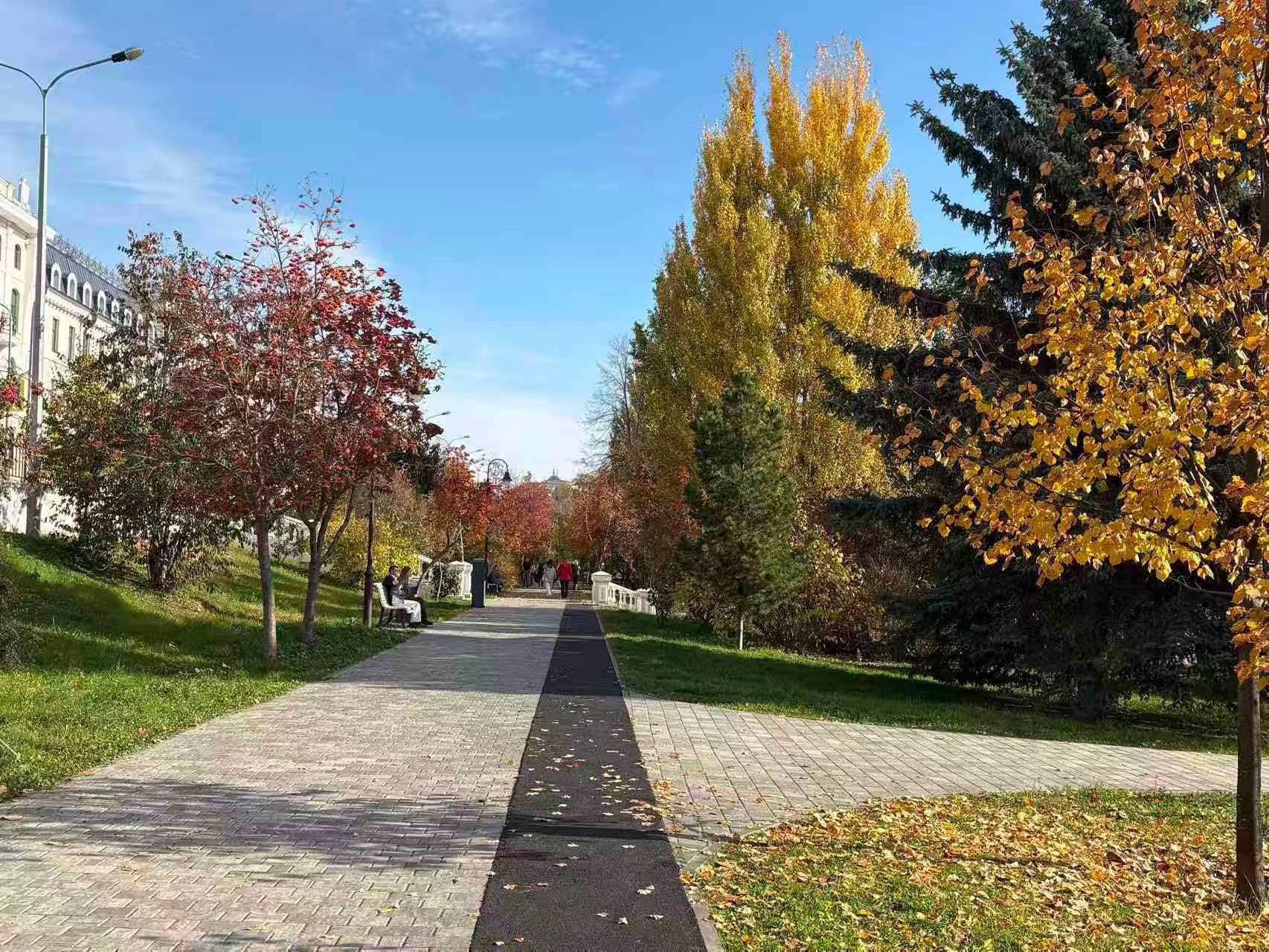
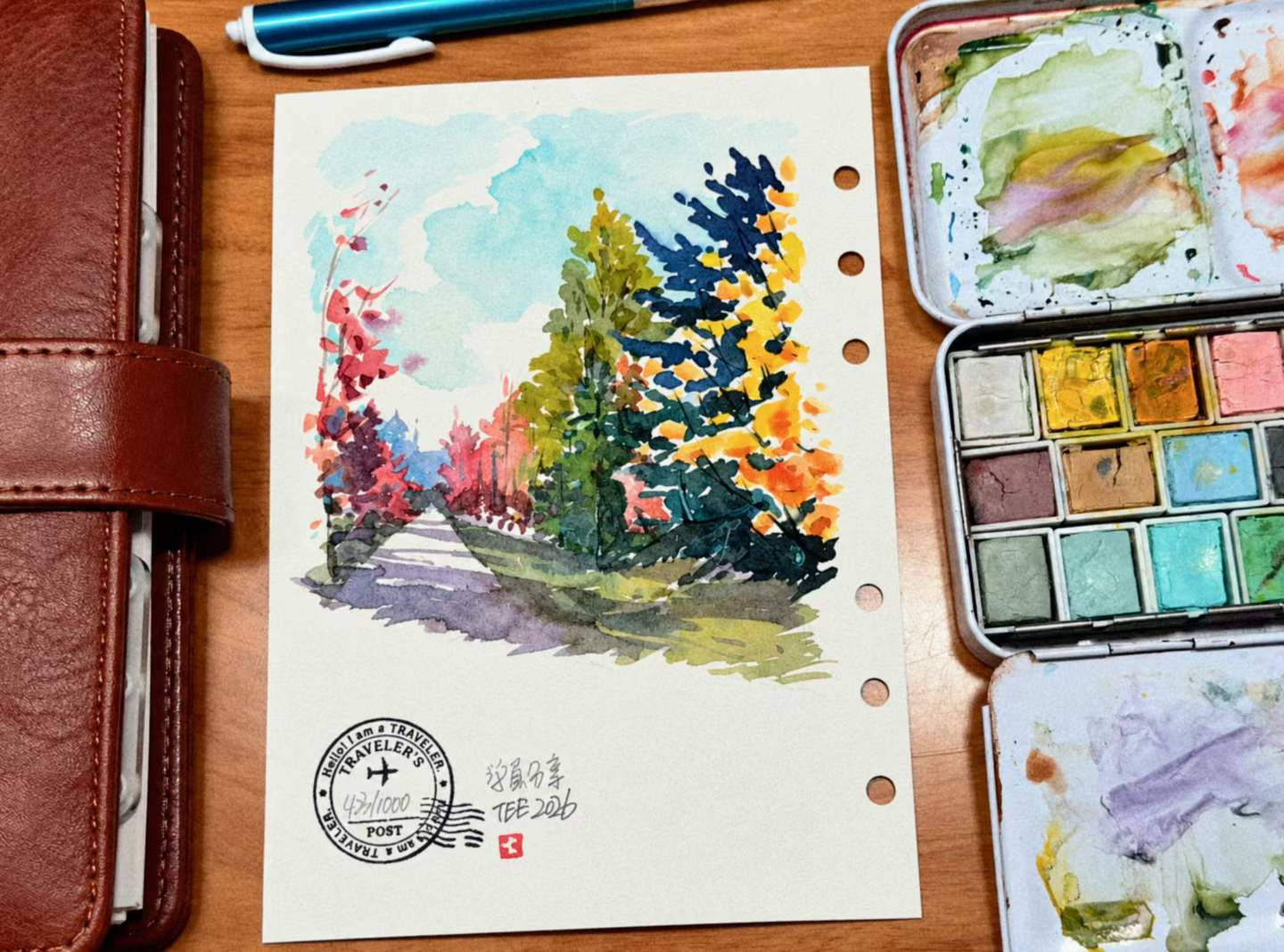
The path in the photograph stretched from the foreground deep into the trees. A dark strip of asphalt ran down the middle, with pale paving on either side. The trees on the left were red, while a row of poplars on the right glowed yellow. There were many different hues, but the whole scene was quiet. Filtered through the trees, the light fell softly on the path, without hard edges.
A bench stood off to the left, with two people sitting on it. Others were walking along the path, one of them dressed in red.
This photograph reminded me of something.
Maxim Gorky came to Kazan at sixteen, hoping to attend university. My Universities tells of those years: he never enrolled, and had to find work on the docks to keep himself fed. The bakery and the docks became his real school.
I had known the title for a long time but had never read the book. It was only after learning that it was set in Kazan that I opened it and read a few pages.
Of course, neither this bench nor the path I painted appears in the book. Gorky was writing about a different generation in late nineteenth-century Kazan. I cannot force the photograph and the book to match.
But it did answer one of my questions.
I had been wondering who walked along such a lovely path every day. Were they going to work, or had they simply come out to sit for a while? Were those two people on the bench waiting for someone, or were they just sitting there?
The answer My Universities offered was not about this path, but about the city: beautiful paths and difficult lives can exist in the same place. The way a city looks and the lives people lead in it are, after all, different things.
When I painted the path, I kept both the bench and the people, and gave them quite a bit of detail. Those people were what the path was really for.
One walk will tell you whether a path is beautiful.
To know where it leads, you have to look at the people walking it.
04 I sat by the water for a while
For the last painting, I chose a different photograph.
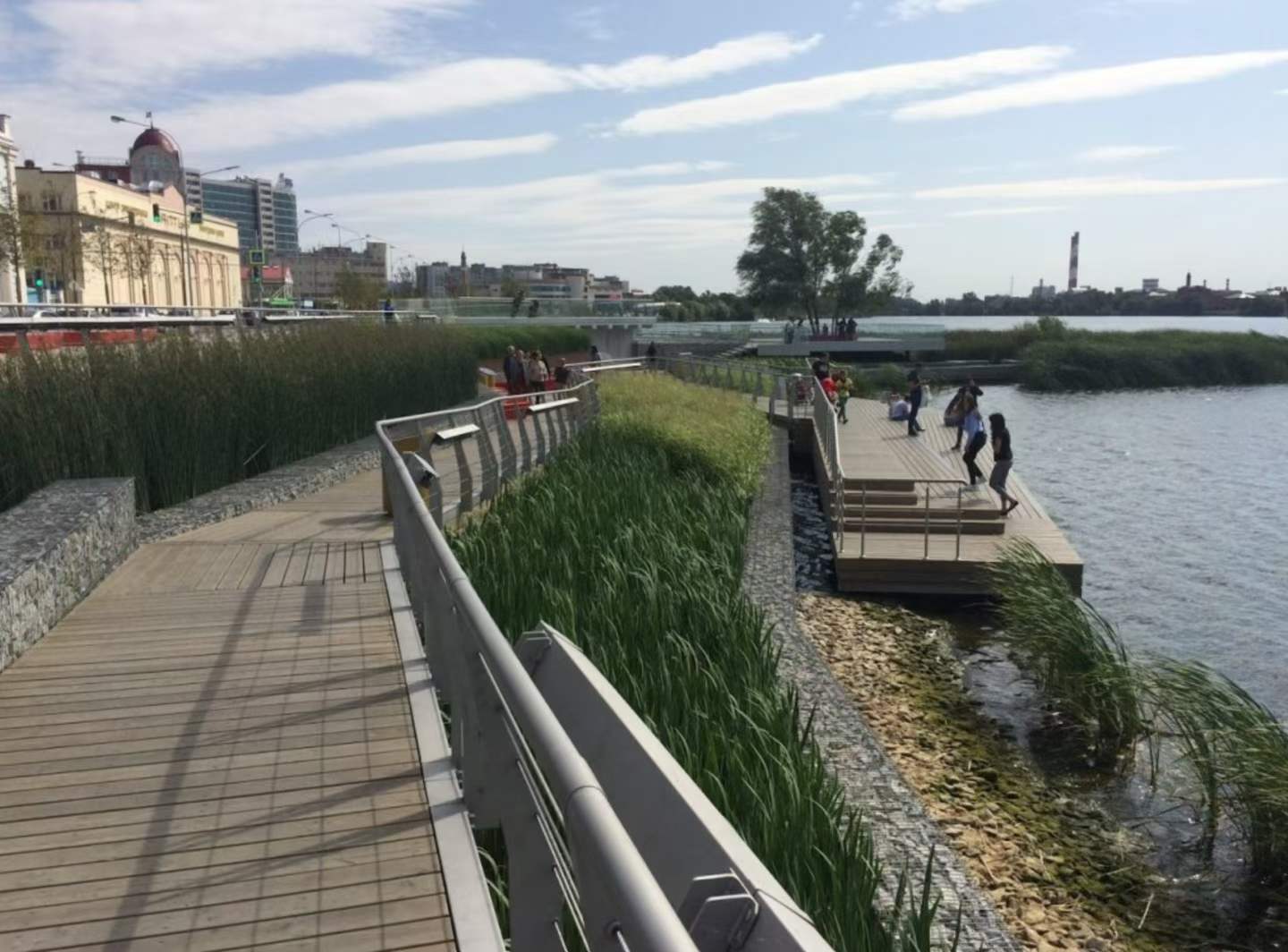
The waterside scene my friend first sent did not particularly make me want to paint. Later, I found another photograph of the lakeshore and used that for this watercolor.
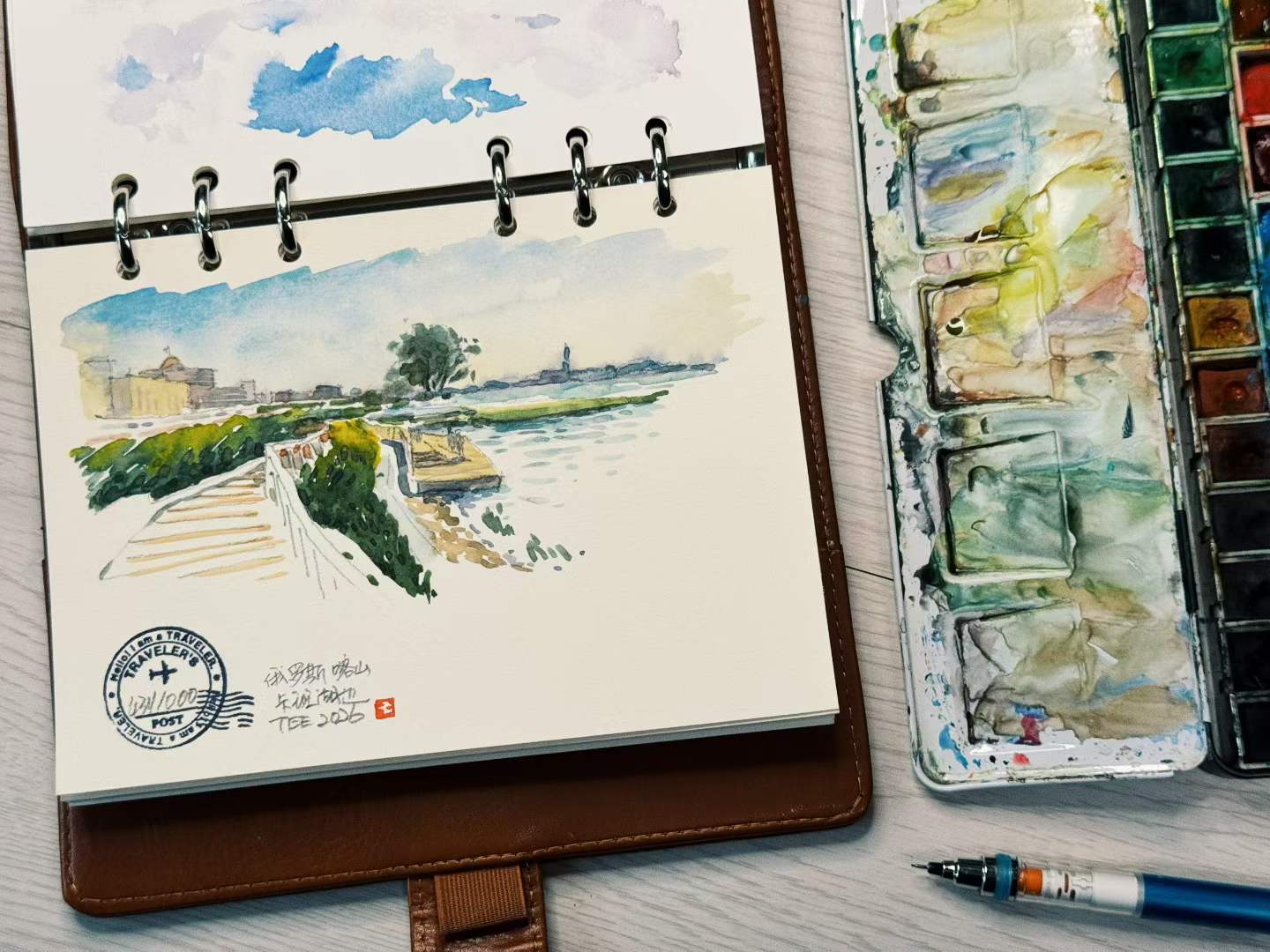
A wooden boardwalk stretched out from the foreground, with tall reeds beside it. A metal railing followed a bend in the walkway. Some people were walking; others sat on the edge of a platform, their feet dangling toward the water. Farther away stood the city's buildings, an old domed building alongside several newer ones.
As I painted, I laid down the blue of the sky in patches, leaving watermarks at the edges. For the lake, I used short horizontal strokes: a few in pale blue, a few in pale gray.
These are the Kaban Lakes, a chain of elongated lakes within Kazan. While looking things up, I came across something I had not expected at all: this waterfront had won an urban landscape award at the World Architecture Festival, and the designers were a team from China.
My own training was in environmental art and design. When I read that, I sat for a while at my painting table.
I was painting a lakeshore in someone else's city. Partway through, I discovered that the people who had helped make it look this way had studied the same field as I had. They had been there, measured the waterline, and thought about whether people would want to stop and stay.
All I was doing was painting it on paper from a photograph. Yet something in the way it felt under my hand changed: that boardwalk was more than scenery. Someone had carefully designed it as a place where people could sit down.
There was also a story. The Tatar poet Gabdulla Tukay wrote a narrative poem called Su Anası, “The Water Mother,” drawing on local folklore. In it, a woman from the water combs her own hair with a golden comb.
I have not found a complete Chinese translation and know only the outline. But the image alone is enough to stay with me: a golden comb, a hand from the water, the act of combing hair.
For people who grew up here, the waterfront may also connect to stories they heard as children, just as the mountains and rivers familiar to us have their own legends. By the waters of Jiangnan, too, there are river deities, and things one should not say carelessly.
When I sent the paintings to that friend, I also asked which of these places they liked to spend time in during an ordinary day.
If the answer is not the most photogenic one,
perhaps that is the direction my next revision should take.
Tee Sang
What did this bring to mind?
Share a memory, a different view, or a thought you would like to continue. No account is needed. Comments appear after review; readers’ words remain in their original language.
Leave a comment
Conversation
Loading comments…